

Never Show Your Hand: Biscuit Krueger and How to Keep a Character’s Power a Mystery
Bisky is 57, looks like a porcelain doll, holds two Hunter stars, and has never fought anyone who could measure her. Yoshihiro Togashi built her that way on purpose, and Hunter x Hunter fans have been arguing about it ever since.
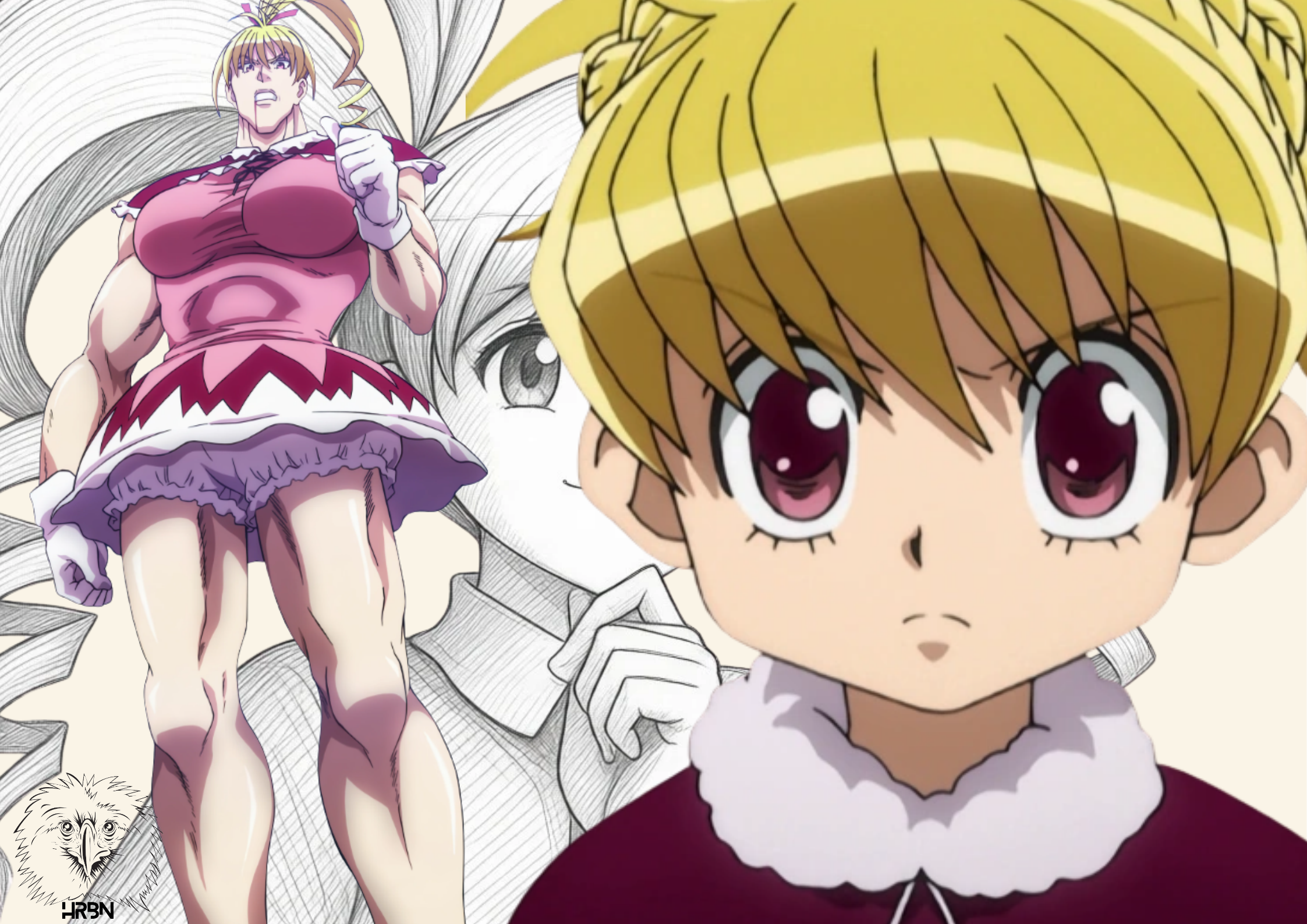
SPOILER WARNING: This article covers Biscuit Krueger’s story in Hunter x Hunter through the Greed Island and Chimera Ant arcs, including her true form, with brief references to the Succession Contest arc. It also discusses Frieren’s battle with Aura in Frieren: Beyond Journey’s End (anime Episode 10) and a major death in the Dark Tournament arc of Yu Yu Hakusho.
Partway through the Greed Island arc of Hunter x Hunter, Gon and Killua’s group uses a spell card to reach a player going by the name Chrollo Lucilfer. They land beside a forest pool and find Hisoka bathing in it. He leaks a little bloodlust, the boys answer with Ren, and he is delighted. They have grown, he guesses they have found a good teacher, and he looks forward to watching them ripen into sweet fruit (Hunter x Hunter Wiki, Chapter 158).
Then he notices the small girl in the doll-like dress. She is drooling at the sight of him, and when he looks her way, she flees in embarrassment to hide behind a tree. Hisoka decides she must be the boys’ teacher and privately guesses she is a Transmuter, the same Nen type as himself. That is the entire assessment. The series’ most famous hunter of strong opponents looks straight at Biscuit Krueger, files her under “teacher,” and moves on.
She files him, too. Facing away from Hisoka, she tells the group she feels a connection to him, while using her aura to signal to the boys that he is lying.
Fans have been replaying that scene for years. A meme posted to a Hunter x Hunter fan group on Facebook, with about 1,400 reactions, opens on Hisoka declaring that he only gets excited for strong opponents, cuts to his blank expression in front of Bisky, points out that this little girl is a Double-Star Hunter, and closes on the complaint that a Hisoka–Bisky fight would have been “the fight we deserved, but Togashi was too scared to draw it.”
The fight never happens, and the absence is deliberate. Across her entire run, Togashi proves exactly how strong Bisky is at minimum and never once lets the story measure her maximum. Bisky even states the principle herself, to a man she has just flattened: you never show your hand (Hunter x Hunter Wiki, Chapter 177). This article calls the technique the open ceiling, and it is one of the most useful tools a writer can borrow for building a powerful character without letting that power take over the story.
Who Is Biscuit Krueger?
Biscuit Krueger, who insists on being called Bisky, is a Double-Star Stone Hunter, a professional who hunts precious gems. The billionaire Battera hires her to help clear the deadly video game Greed Island, but her real target inside it is a rare gem called Blue Planet (Hunter x Hunter Wiki: Biscuit Krueger). She is 57 when she debuts (Sportskeeda, character ages) and looks like a child. Her true form is a towering, heavily muscled woman she cannot stand.
She began learning Nen at 17, studied Shingen-ryu kung fu, served as a Hunter Exam examiner, and trained Wing, the man who first taught Gon and Killua Nen. When she takes over the boys’ training in the 2011 anime’s Episode 63, “A × Hard × Master?”, her credential is simple: she is their teacher’s teacher (Hunter x Hunter Wiki, Episode 63).
She trains them because she cannot resist potential. Comparing the boys to gems, she wonders why polished things that shine always set her heart racing. For a woman whose profession is finding stones and whose habit is naming them, students are the same pleasure in another form.
How Strong Is Biscuit Krueger?
At minimum, strong enough to flatten a hardened killer with one punch. At maximum, nobody knows, and that split is the whole design.
Power-scaling communities sort evidence into feats, the things a character is shown doing, and statements, the things the story says about them. Togashi hands Bisky’s fans a generous stack of feats, and every one of them sets a floor.
The first is Binolt, a killer stalking players on Greed Island. Bisky senses his bloodlust while Gon and Killua notice nothing, lets him cut her hair to draw him out, and then drops him with a single palm strike thrown without Nen. He vomits blood and briefly blacks out, and she tells him a real Nen fight would have killed him. Earlier in the same chapter, she slaps Killua as a decoy, and the boy raised as an assassin never sees her hand move (Hunter x Hunter Wiki: Biscuit Krueger).
The training adds more. She runs the boys 70 kilometers to the town of Masadora and back, finishing fresh while they are winded. She demonstrates Ko by moving her hand so slowly that Gon can watch it coming, and it still knocks him back several meters with a nosebleed through his defense. In a later sparring session, she walks away without a mark after covering Killua in bruises, then names the habit that will haunt him: getting ready to flee the moment he faces someone he believes is stronger.
In Razor’s lethal dodgeball match, she is the only player who leaves completely unhurt, and she is eliminated only because a ball clips her baggy skirt.
Then there is Bara, a member of Genthru’s Bomber team, in the arc’s final battle (adapted in the 2011 anime’s Episode 73). Bisky uses a spell card to teleport the two of them to an empty beach. In her small form she lands a string of kicks and punches; he laughs them off and knocks her down. Then she begins to grow. She always lets an opponent land one blow first, she explains, because in her true form she cannot restrain her punches and usually kills whoever she hits. One punch crushes his face and sends him into the air. When the beaten Bara asks why she hid her strength, she gives two reasons: you never show your hand, and she hates being that muscular (Hunter x Hunter Wiki, Chapter 177).
That is the floor: fast enough to blindside Killua and strong enough to one-punch a hardened killer, with all of it kept inside a doll-sized body.
The Ceiling Togashi Never Shows
Now look for her maximum. It is not on the page.
Every opponent Bisky has fought was a threat to her students and a formality for her. The only special ability she has revealed is a Nen-made masseuse, and the Hunter x Hunter Wiki notes that she has yet to show any offensive ability at all and that her full power remains unknown (Hunter x Hunter Wiki: Biscuit Krueger). A 2022 “respect thread” on Reddit, the kind of post fans compile to catalog a character’s feats, notes that her true form has exactly one: the punch that dropped Bara (r/respectthreads).
Even the transformation stays opaque. In the Succession Contest arc, Bisky admits she does not know how she came by the ability to look young; she wished for it for years, and the change arrived little by little. The character hiding the ceiling cannot fully explain the floor.
What Does Double-Star Hunter Mean?
Her rank is the closest thing fans have to an official number, and it measures contribution to the Hunter Association. Under the association’s bylaws, one star goes to a Hunter with remarkable achievements in a single field. Two stars require meeting the first five bylaws, holding an official position, and having mentored a junior Hunter who earned a star. Three stars are reserved for remarkable achievements across several fields (Hunter x Hunter Wiki: Hunter Association). Bisky’s second star is partly a teaching credential.
That settles the comparison fans raise most often. Ging Freecss is also a Double-Star Hunter, and the shared rank says nothing about whether the two are equal in a fight. What separates them is what Togashi attaches to each. Ging gets a statement: Chairman Netero counts him among the five best Nen users in the world (Sportskeeda on Ging). Bisky gets none. Fittingly, she is the one who passes Netero’s verdict on Ging along to Gon. In Hunter x Hunter, Bisky does the measuring. Nobody measures her.
Togashi Knows How to Measure a Mentor
He has done it before, and the measurement has always cost the character dearly. In Yu Yu Hakusho, Togashi’s earlier series, the aging martial-arts master Genkai, whom the Hunter x Hunter Wiki itself compares to Bisky, faces her old teammate Toguro before the Dark Tournament final. He sees the limits of her strongest attacks, says he should have killed her when she was young and at her peak, and kills her (YuYu Hakusho Wiki, Chapter 90). Togashi later brings her back, but the scene has already done its work. In Hunter x Hunter itself, Chairman Netero spends every technique he has on the Chimera Ant King Meruem, cannot win, and detonates the bomb implanted in his own heart (Sportskeeda on Netero and Meruem).
With Bisky, Togashi never stages that scene. He has already written the version where the old master gets measured. For her, he left the ceiling open.
The Open Ceiling, Defined
The open ceiling: a character whose minimum strength is proven on the page and whose maximum is never tested. The working rule fits on an index card: show the floor, hide the ceiling.
Both halves matter. Without the floor, the character is merely unexplained, and readers have nothing to argue with. Without the hidden ceiling, the argument ends the moment the character wins or loses a fair fight. Bisky works because Togashi keeps adding to the floor and never tests the ceiling.
Literary theory explains why the empty space holds readers. The German scholar Wolfgang Iser argued that texts work through gaps, places where the writing leaves something undetermined for the reader to supply, and that “each individual reader will fill in the gaps in his own way” (Quartz). Bisky’s ceiling is a gap of exactly that kind, and Hunter x Hunter readers fill it in public, one confident comment at a time.
Psychology explains why the gap never feels finished. In his information-gap theory, the economist and psychologist George Loewenstein describes curiosity as a kind of deprivation that arises when attention locks onto a gap in what we know (Psychological Bulletin, 1994). Curiosity needs some knowledge to get started, and it tends to grow as knowledge grows (PBS NOVA). Togashi’s floor feats are that knowledge. Every new data point (one punch, seventy kilometers, a skirt) makes the gap feel smaller and more answerable, so the debate gets louder instead of quieter. One fight would close it. That fight is the one thing Togashi never draws.
Is Biscuit Krueger Stronger Than Hisoka?
Hunter x Hunter never says, and the evidence on the page supports both camps. The comment sections prove it.
In a separate Facebook thread about the same scene, the top reply, with 130 reactions, insists that “Bisky’s main plot is literally hiding her true strength” and argues that she read Hisoka at once while he never sensed her. Another commenter answers the whole debate with “There’s this thing called Zetsu. Look it up,” pointing to the Nen technique that shuts off a user’s aura. A third supplies a motive the manga supports: she has spent her life hiding her strength because she does not like how her true body looks.
The other side is just as certain. One fan grants that Bisky is strong but still picks Hisoka, because “dude is a menace.” Another reads Hisoka’s indifference through his own logic: he wants opponents still approaching their peak, and Bisky has passed hers. That drew a quick rebuttal: by that logic, Netero and Ging have not peaked either, yet Hisoka wanted to fight both. The past-her-peak camp is, without knowing it, reciting Toguro’s logic from Yu Yu Hakusho. And one reply offered the simplest reading of all: an old woman noticing an attractive man. Since the manga does show her drooling over a naked Hisoka, that camp has canon on its side too.
Then there is the oldest objection, raised whenever fans file Bisky under “teacher” instead of “fighter.” George Bernard Shaw put it most bluntly in Man and Superman: “He who can, does. He who cannot, teaches” (Project Gutenberg, Maxims for Revolutionists). It sounds decisive until Binolt and Bara come up. It also cannot be disproven, because nobody has ever seen Bisky fight someone her own size.
Read the pool scene closely and both characters come out of it accurate. Hisoka reads her role and her Nen type correctly. Bisky reads him correctly too: in the next chapter, she tells the boys he is not telling them the whole truth, and when Killua asks how she can be sure, she cites more than fifty years of her own lying (Hunter x Hunter Wiki, Chapter 159). Two liars size each other up, each sees exactly what the other allows, and neither shows a hand. Every camp is right about what it can see. That is the open ceiling at work.
Why Togashi Leaves the Ceiling Open
It Protects the Students’ Story
A mentor with a known, superior ceiling raises an awkward question in every arc: why doesn’t she just handle it? Brandon Sanderson’s First Law addresses the problem from the magic side. The less readers understand a power, the less satisfying it is when that power resolves a conflict, which is why, Sanderson notes, Gandalf never simply flies Frodo to Mount Doom (Sanderson’s First Law). Haribon Publishing’s breakdown of Fullmetal Alchemist’s magic system applies the same laws to alchemy.
Hunter x Hunter’s Nen system is famously rule-bound, but Bisky’s personal limit stays soft, so Togashi spends her strength on everything except the climax. She teaches. Her Nen masseuse lets the boys recover in a fraction of the usual time. And in the one battle where she reveals her true form, she first teleports her opponent to an empty beach, physically removing her fight from the main event. The climax belongs to Gon and Genthru.
It Comes From Inside the Character
A withheld ceiling feels like an authorial dodge when nothing in the character explains it. Bisky’s comes with two motives she states herself: strategy, because you never show your hand, and vanity, because her true form does not match her idea of femininity. She is also, by her own account, a lifelong liar (Hunter x Hunter Wiki: Biscuit Krueger). Concealment is who she is, so readers never catch Togashi hiding the ball. They catch Bisky.
It Keeps Her Reusable
A measured ceiling becomes a benchmark that every later threat has to clear or contradict. An open one costs nothing. Bisky returns in the Chimera Ant arc to drill Gon and Killua for their daily bouts with Knuckle and Shoot, and in the Succession Contest arc as a royal bodyguard aboard the ship bound for the Dark Continent. The next time she reveals her true form on the page, it is to convince a skeptical royal guard that Nen is real, along with a promise that a talented student’s physical strength can double or triple in a month. The second time Togashi shows her real body, it is a lecture.
Bisky and Frieren: Two Ways to Hide a Ceiling
The Frieren comparison came up in the comments, too. One of the most-liked replies says Bisky hides her aura the way Fern and Frieren hide their mana, and a reply to it went further, calling her this universe’s Frieren.
The parallel holds. Frieren’s teacher, Flamme, taught her to suppress her mana for her entire life so that demons, who judge strength by visible mana, would underestimate her, and Frieren passed the habit to Fern, as traced in “To a Moderate Degree”: Frieren, Fern, and How to Write the Same Character Twice. Bisky’s small body does the same job against fighters who judge by appearance.
The difference is the payoff. Kanehito Yamada brings a scale. In Episode 10, “A Powerful Mage,” the demon Aura weighs both souls on her Scales of Obedience, the balance tips toward Frieren, and Frieren ends the fight with a single command (Sportskeeda, Frieren Episode 10). Frieren’s hidden ceiling is a setup with a scheduled payoff. Bisky’s is never paid off. Frieren’s restraint is part of what makes her the open, understated character described in Frieren Is a Quiet Canvas. Bisky’s restraint has a different effect on her audience: every reader supplies a different number.
Black Clover’s Dorothy Unsworth runs on a related engine, a promise of power contradicted by behavior until a decisive payoff, which Haribon Publishing’s Dorothy breakdown calls the status-behavior gap. Bisky is that setup with the payoff deliberately withheld. Both work. The craft decision is knowing which one you are writing.
Biscuit Krueger’s Powers and Abilities
Everything below is drawn from the series as catalogued by the Hunter x Hunter Wiki.
Nen Type: Transmutation
Bisky is a Transmuter who also appears proficient in Emission, Enhancement, and Manipulation. Her training exercises cover every category a Transmuter can access, and she demonstrates them herself.
Magical Esthetician (Cookie)
Her signature ability summons Cookie, a Nen-made masseuse whose massage techniques and Nen-transmuted lotion relieve fatigue and restore vitality. Cookie can also burn off excess fat and ease arthritis, muscle tension, and locked joints.
Piano Massage
Cookie’s best-known technique makes 30 minutes of sleep equal to eight hours and speeds up the recovery of aura. With it, Gon and Killua compress more than a year’s worth of aura training into a month.
Body Transformation (True Form)
At will, Bisky can return to her true form, a massive, muscular woman several times the size of her preferred one. Her physical strength jumps enormously while her Nen stays roughly the same. Her childlike form severely reduces her physical abilities, which is the price of the disguise.
Mastery of Basic and Advanced Nen
She has shown Ten, Zetsu, Ren, Hatsu, Gyo, In, Shu, Ko, Ken, and Ryu; En is the only advanced technique she has never displayed. She holds Ko for 30 minutes without effort, and by her late twenties she could redistribute her aura with a margin of error under one percent.
Shingen-ryu Kung Fu
She is a master of the style and trained Wing in it.
Speed, Stamina, and Strength
Even in her small form, she runs 70 kilometers in 150 minutes without strain, blindsides Killua, and drops Binolt with a palm strike thrown without Nen. In her true form, one punch knocks Bara out.
Perception and Lie Detection
She detects Binolt’s bloodlust before her students do, and she reads Hisoka’s evasions, crediting more than fifty years of her own lying.
Teaching
She designs training around each student, the terrain, and the resources at hand, and she claims she can double or triple a talented beginner’s physical strength within a month.
Stone Hunter Expertise
Her access to classified Hunter information told her the Blue Planet could be found only inside Greed Island. When she finally claims it, she names it Plu-chan.
Known Limits
The disguise costs her most of her physical power until she transforms. She deliberately lets opponents land the first blow. She has never displayed En or an offensive special ability. And she has never been tested against a peer, which is exactly the point.
How to Write an Open Ceiling
Five moves transfer directly.
1. Prove the Floor With Cheap, Decisive Feats
Let the character casually beat someone the reader already fears. Bisky’s palm strike on Binolt takes a page and sets a minimum for the rest of the series.
2. Pick Opponents Who Can Measure the Floor but Not the Ceiling
Binolt and Bara are deadly to the students and trivial to the teacher. The fights read as real, and they reveal nothing about her limit.
3. Give the Concealment a Motive Inside the Story
Vanity, strategy, ethics, fear. When the character has a reason to hide, readers credit the character instead of suspecting the author.
4. Let Skilled Characters Read Everything but the Number
Hisoka reads Bisky’s role and type correctly; Bisky reads Hisoka’s evasions correctly. Accurate partial readings make the missing number feel deliberate.
5. Spend the Power on Other People, and Decide Whether It Ever Pays Off
An unmeasured mentor should make others stronger instead of solving the climax. Then decide whether the reveal ever comes: Yamada gives Frieren a scale, and Togashi never gives Bisky one. Both work, as long as the choice is made on purpose.
Credit Where It Belongs
Hunter x Hunter is written and illustrated by Yoshihiro Togashi and has run in Shueisha’s Weekly Shōnen Jump since 1998, with anime adaptations by Nippon Animation in 1999 and Madhouse in 2011. Bisky’s open ceiling is built from small, disciplined refusals: a fight relocated to an empty beach, an ability shown only as a massage, a rank that measures teaching, and a glance from Hisoka that stops at “teacher.”
The meme says Togashi was too scared to draw the fight. The page suggests something more deliberate. Togashi drew everything around it (the floor, the motive, the rank, two liars at a forest pool) and left blank the one panel that would end the argument. The fight fans deserved is the one they keep having.