

"To a Moderate Degree": Frieren, Fern, and How to Write the Same Character Twice
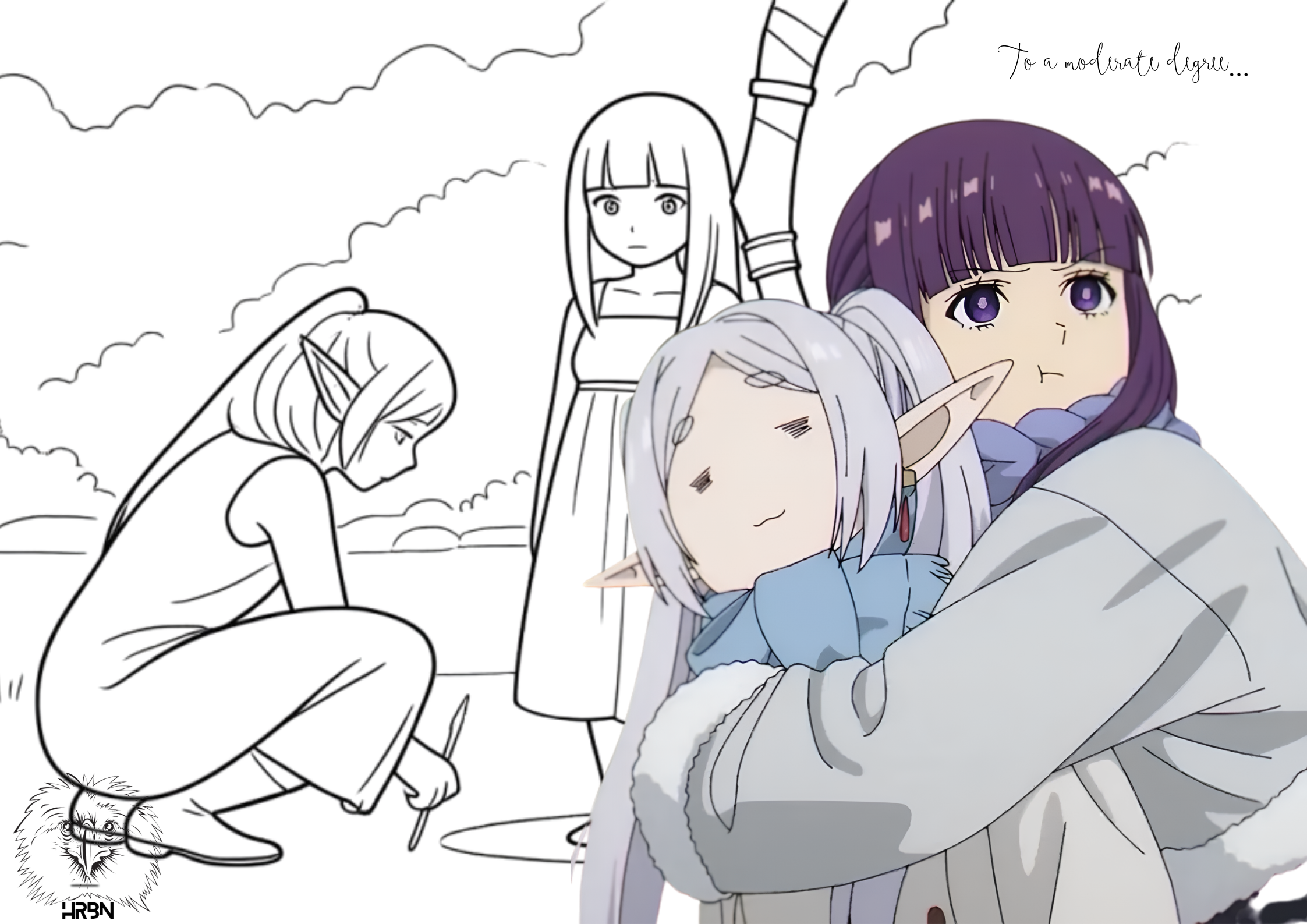
Asked whether she likes magic, a young Fern says she likes it to a moderate degree. Frieren's reply is that the two of them are alike. Kanehito Yamada spends the rest of the story proving the elf right, and lets Fern take her time agreeing.
SPOILER WARNING: This article is spoiler-heavy. It covers Frieren: Beyond Journey's End through the end of the First-Class Mage Exam arc (the anime's first season), with one brief reference to the first episode of the second season. It also mentions a character's past suicide attempt.
In the first episode of Frieren: Beyond Journey's End, the elf mage Frieren finds Fern, the young orphan her old comrade Heiter has taken in, practicing magic alone at a ravine, and asks her whether she likes it.
Fern says she likes magic to a moderate degree. (Some English releases render the line as "somewhat.") Frieren's response is that the two of them are alike in that (Daddy Jim Frieren Wiki, Episode 1).
It is a small joke, and neither of them is being honest. One is a thousand-year-old elf who trades odd jobs for spells as small as one that warms tea, one that sours sweet grapes, and one that strips rust from bronze (Daddy Jim Frieren Wiki, Chapter 3). The other is a war orphan who will spend the next four years drilling until she can strike a distant boulder from a cliff, the benchmark Heiter set for standing on her own (Daddy Jim Frieren Wiki, Chapter 2). "Moderate" describes neither of them. It is also the first thing they have in common.
Haribon Publishing author Marjorie Gavan, a writer from Manila whose work explores heartbreak, identity, and quiet personal revolutions, summed up the idea behind this article in one line: Frieren and Fern are the same character in different packaging. Her debut poetry collection, The Prelude Girl, was published in 2025.
The phrase is more exact than it sounds. It names a specific technique, and it explains why Kanehito Yamada's two leads read as a matched pair rather than a teacher and her sidekick.
What "Different Packaging" Means
Two established craft terms sit close to it. A foil is a character who brings out another character's traits through contrast. A mirror character, in TV Tropes' definition, shares significant similarities with another so that each one's traits come into sharper focus.
Frieren and Fern are both at once: foils on the outside, mirrors on the inside. The technique depends on keeping those two layers separate.
The outside is all contrast. Frieren is more than a thousand years old, sleeps late, and has a running habit of climbing headfirst into treasure chests that turn out to be mimics. Fern is a teenager who behaves like the adult in the room. She wakes Frieren, makes sure she gets dressed, and keeps her on task (The Outer Haven); in daily life, the apprentice plays something close to a mother's role (Moegirlpedia: Fern). Frieren drifts. Fern plans. Frieren is blunt. Fern is unfailingly polite and can be quietly cutting.
That outer layer is where the comedy lives. Every scene of Fern hauling a half-asleep elf through the morning is a scene of difference, and difference is easy to write and easy to enjoy.
The inside is another matter. Strip the surface away and the two of them are built from the same four parts.
The Same Rescue
Both lost everything as children, and both were pulled out by someone who handed them magic as a way forward. Frieren was the last survivor when demons destroyed her elven village; the human mage Flamme took her in, and Frieren trained under her for fifty years (Moegirlpedia: Frieren). Fern lost her parents to war in the Southern Lands. The priest Heiter found her at the edge of a cliff, stopped her from ending her life, and raised her (Wikipedia: List of Frieren episodes). She studied magic to repay him by proving she could live on her own.
The Same Hiding
Flamme taught Frieren to suppress her mana for her entire life, so that demons, who rank one another by visible mana, would underestimate her. Frieren has kept it up for centuries. When she arrives for the First-Class Mage Exam, the veteran mage Lernen sees at a glance that she is concealing a reserve nearly matching that of Great Mage Serie herself, a deception that, before him, only the Demon King had ever seen through on sight (Daddy Jim Frieren Wiki, Chapter 57).
Frieren passed the habit to Fern, who has hidden her own mana since childhood (Frieren Wiki: Fern). She does it well enough that the demon Lügner, fighting her during the Aura arc, realizes only as he dies that Fern had been restricting her mana exactly as Frieren does (Moegirlpedia: Fern).
The power system is making a point about personality. Both characters hide what they have. They hide their mana from demons, and they hide how much they care from nearly everyone, including each other. The magic and the manner run on the same mechanism.
The Same Understatement
That is what "to a moderate degree" really is: the spoken version of mana suppression, a modest reading laid over a much larger reserve. Frieren recognizes the move the moment she hears it, because it is her own.
The Same Answer to the Great Mage
Serie, the elf who founded the Continental Magic Association (The Mary Sue) and once taught Flamme (Moegirlpedia: Serie), runs the final stage of the First-Class Mage Exam herself. Given one last chance, Frieren is asked for her favorite spell. She names the spell that makes a field of flowers, the one Flamme taught her. Serie scoffs and fails her (Daddy Jim Frieren Wiki, Chapter 57).
Fern passes, and as a new first-class mage she may ask Serie for practically any spell as her privilege. She asks for one that cleans clothes, which annoys Serie greatly (MyAnimeList, Episode 28).
Faced with the Great Mage herself, teacher and student give the same kind of answer: something small, domestic, and loved. Neither is making a point. To both of them, that is simply what magic is for.
Do Frieren and Fern Ever Admit They're Alike?
Frieren does, more than once. Fern, at least through the first season, never quite does, not in words.
Frieren's first acknowledgment is the ravine scene in Episode 1. Her second comes in the half of Episode 2, "It Didn't Have to Be Magic...," adapted from the manga's third chapter, "Blue-Moon Weed." Early in their travels, Fern says she thinks the two of them feel slightly differently about magic. Frieren insists they are the same (Frieren Wiki: Episode 2).
Fern pushes back. Magic, for her, was a means to an end: she learned it to repay Heiter, and it did not have to be magic. Frieren's answer is that Fern chose magic anyway (Anime Rants). Fern smiles, and the conversation ends there.
Her agreement arrives later, and it arrives as action. In the third exam, Fern alone perceives the instability hidden in Serie's mana. Delighted, Serie asks her to become her apprentice. Fern turns her down, twice in the anime's telling, and declares herself Frieren's student (Daddy Jim Frieren Wiki, Episode 27). Then she spends her first-class privilege on a laundry spell.
Why the Asymmetry Works
The structure is deliberate, and it is portable. The older character names the likeness. The younger one resists it, then proves it without saying so. The reader is left holding both the claim and the evidence and draws the conclusion alone.
Fern's resistance is characterization, too. Her account of herself rests on magic as a way of repaying a debt. Admitting she is like Frieren would mean admitting she loves magic for its own sake, which is exactly what "to a moderate degree" exists to hide.
There is a second payoff underneath. Fern's packaging is attentive to people in a way Frieren's is not. She reads moods, sulks when she is hurt, and tells Frieren plainly that she is overjoyed simply because Frieren tried to get to know her (Anime Rants). That attentiveness is the very thing Frieren set out on her journey to learn. Yamada gave the student, as packaging, the trait the teacher is traveling to acquire.
The Mirror Scene
Eventually Yamada makes the idea literal. In the second stage of the exam, the examinees descend into a dungeon where a monster called Spiegel, German for "mirror," produces copies of the people who enter. One of the copies is Frieren.
Fern volunteers to kill it, and she works out the weakness the plan depends on: for a moment while casting, Frieren stops detecting mana (Epicdope). In the manga's fifty-fifth chapter, adapted in the anime's twenty-sixth episode, Frieren deliberately takes a blow from her copy to open a bigger gap, and Fern lands the fatal attack (Frieren Wiki: Chapter 55).
Anime News Network's review of that episode offers the sharpest reading of the fight. The flaw the pair really exploits, it argues, is not the casting gap. It is that Frieren has constantly underestimated Fern, and her copy, carrying the same assumptions, underestimates her too (Anime News Network, Episode 26 review).
That is "different packaging" stated as plot. The copy has Frieren's packaging and Frieren's blind spots. Fern has Frieren's core inside packaging of her own. A perfect copy of the teacher loses to an imperfect one.
A New Edition, Not a Reprint
Pull back and the pattern runs through four generations. Serie taught Flamme. Flamme taught Frieren. Frieren taught Fern. Each inherits the core of the one before and arrives in new packaging.
Serie, a mage shaped by an age of endless war, treats magic as a tool. Frieren, shaped by a more peaceful era, treats it as something wonderful (Anime News Network, Episode 27 review). That old disagreement is part of why Serie fails Frieren, and it is fitting that Fern, raised on Frieren's version, turns Serie down. Reviewers have noticed the rhyme running upward, too: Anime Corner observed that Serie's bond with her human apprentice Flamme recalls Frieren's with Fern (Anime Corner).
Publishing has a useful word for what Fern is. A reprint reproduces a text exactly. A new edition keeps the text and changes the binding, the typesetting, and a few of the corrections. Fern is Frieren's text in a new binding: faster in a fight, quicker to notice people, and human, with a lifespan short enough to make every year count.
Frieren and Fern's Powers and Abilities, Explained
The two share a foundation: ordinary offensive and defensive magic refined to an unusual degree, plus mana concealment passed down in a direct line from Flamme. Where they differ is breadth against speed.
Frieren
Offensive Magic and Demon Slaying
Frieren is so proficient with offensive magic, including spells built to kill demons, that senior demons know her as "Frieren the Slayer" (Moegirlpedia: Frieren). The series' standard attack, Zoltraak, began as the demon Qual's lethal killing spell; within roughly eighty years, human mages had turned it into ordinary offensive magic that a trained mage can block (Anime Rants).
Mana Concealment
A lifelong suppression of her true reserve, taught by Flamme and maintained for centuries, deep enough to hide mana nearly on Serie's level.
Spell Analysis and Folk Magic
Frieren learns spells by studying them. After finding living blue-moon weed, she analyzes a sample and acquires the magic to make the flower bloom (Daddy Jim Frieren Wiki, Chapter 3). She also collects folk spells for everyday tasks, often trading a day's work for one.
The Flower-Field Spell
Her favorite spell, inherited from Flamme. A flashback ties it to Himmel, who as a lost child watched an elf cast it and understood for the first time that magic could be beautiful, the chance meeting that later drew Frieren into his party (Daddy Jim Frieren Wiki, Chapter 57).
Flight
She can fly, as when she rises to the top of an abandoned watchtower in search of blue-moon weed.
Fern
Zoltraak
Ordinary offensive magic is the only offensive spell Fern uses (Frieren Wiki: Fern). She has no need for anything more exotic.
Casting Speed
According to Frieren, battles end more quickly when Fern fights.
Mana Concealment
Practiced since childhood and precise enough to fool demons, as Lügner discovers too late.
Mana Perception
She alone sees the instability hidden in Serie's mana during the third exam, something Serie privately laments her own apprentice Lernen never managed (Daddy Jim Frieren Wiki, Chapter 57). She is also the one who finds Frieren's momentary blind spot while casting.
Control and Precision
Early in her training, Frieren judged that Fern's mana would take years to grow but that her control already surpassed most mages' (Daddy Jim Frieren Wiki, Episode 2). Her first benchmark was hitting a distant boulder from a cliff.
Defensive Magic
Like most modern mages, she casts hexagonal protective barriers that can shield a location or encircle her.
First-Class Mage
Fern passes the First-Class Mage Exam; Frieren does not. Her privilege spell, chosen from nearly anything Serie could offer, cleans clothes.
Where Their Magic Stops
Frieren's Limits
The casting gap is real: for a moment while she casts, Frieren stops detecting mana, and an opponent who knows that can time an attack to it. Her other weakness is less technical. She has repeatedly underestimated her own student, and the series treats that as a tactical flaw as well as a personal one.
She also cannot get past Serie. The Great Mage fails her and then bans her from every Continental Magic Association building for the next thousand years (MyAnimeList, Episode 28), a limit of a different kind.
Fern's Limits
Her offensive repertoire is narrow by design. Speed and precision make Zoltraak enough most of the time, but she fights with one offensive spell. Her reserve was still growing when her training began, and control rather than raw output is her signature.
The most revealing limit is emotional. When Fern cannot rely on magic, she feels as though she has been thrown into darkness (Frieren Wiki: Fern). The second season's first episode stages exactly that: trapped in a cave of magic-nullifying crystals, Fern loses her sense of mana, and the animation surrounds her with darkness (usaanime.us).
A person who likes magic to a moderate degree does not experience its absence as darkness. The limit exposes what the understatement was covering, and it is the same thing Frieren's understatement covers.
What Readers Keep Noticing
Marjorie Gavan is far from the only reader to catch the resemblance. Anime Rants noted in its early-episode notes that the two are alike in their dedication to magic, whatever Fern claims. Anime News Network's reviewer concluded that Frieren keeps underestimating Fern even with high expectations of her. Anime Corner saw the same shape one generation up, in Serie and Flamme.
The series lets its audience complete the resemblance instead of announcing it, which is precisely why so many readers arrive at it on their own.
How to Write the Same Character Twice
Five things transfer directly.
1. Build the Core Before the Packaging
Decide what the two characters share underneath: what they lost, what they love, and how they hide it. Then design surfaces that contradict each other. Frieren and Fern share an origin, a technique, and an understatement, and almost no habits.
2. Give Them One Answer to Share
Fern gives the answer; Frieren claims it as her own. One shared answer does more work than pages of parallel backstory, because the reader hears the echo instead of being told about it.
3. Let One Name It and the Other Resist
Asymmetry generates tension. One character makes the claim; the other supplies the evidence while denying it. The reader closes the gap.
4. Prove the Kinship Through Choices
Fern never says she is like Frieren. She turns down the Great Mage to remain Frieren's student, then asks for a laundry spell. Readers trust a choice more than a declaration.
5. Put the Mirror Into the Plot Once
Give the shared core at least one scene where it decides an outcome. Fern beats Frieren's copy because she shares Frieren's core without sharing Frieren's blind spot.
Credit Where It Belongs
Frieren: Beyond Journey's End is written by Kanehito Yamada and illustrated by Tsukasa Abe, and has run in Shogakukan's Weekly Shōnen Sunday since 2020; the anime is produced by Madhouse. The kinship between its two leads is assembled from small, quiet decisions, and almost none of them are announced.
Marjorie Gavan's phrase holds because it identifies what Yamada avoided. He did not make Fern a copy, and he did not make her an opposite. He gave her Frieren's contents and new packaging.
Frieren asked a girl at a ravine whether she liked magic and heard her own answer come back. It was an understatement both times, and it meant the same thing both times.