

When You’re Not the Priority: On Being Unchosen and Choosing Yourself Anyway
Some of us grew up as the one who was always expected to understand.
The one who was told to wait. To give way. To be happy with less, because someone else needed it more — and because you were the strong one, the smart one, the one who would be fine. You learned early to swallow the question before it reached your mouth: but what about me? You learned that asking it out loud only made you the difficult one, on top of everything else.
If that is a language you speak, there is a scene in A Series of Seemingly Unrelated Love Stories, the debut novel by author and illustrator Lorelie Defensor, that is going to find the exact place where you keep that old ache. It is the emotional heart of the book’s second act, and it is coming soon from Haribon (HRBN) Publishing.
Celebrated in Public. Told No in Private.
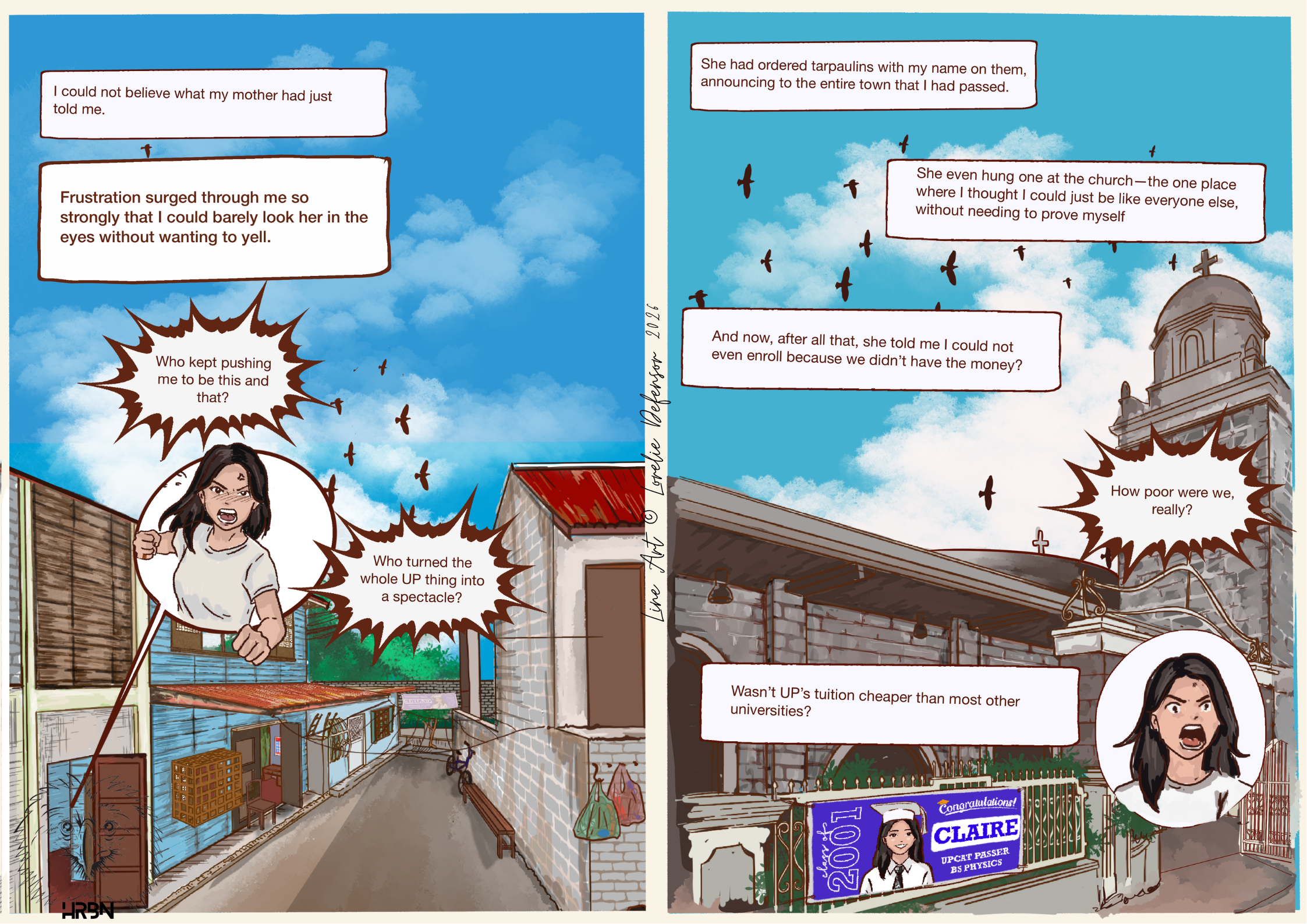
Here is what happens to Claire. She passes — the exams that were supposed to decide everything, the ones her whole family had been praying over. And her mother is so proud that she does the most Filipino thing imaginable: she orders tarpaulins with Claire’s name on them and hangs them around town. She even puts one up at the church — the one place, Claire says, where she thought she could just be like everyone else, without needing to prove herself. Her achievement, strung up at the parish plaza for the whole town to read.
And then, over lunch, two days after graduation, the same mother tells her she cannot enroll. There is no money. “Your sister is graduating this year,” she says. “We have to prioritize her.”
Sit with the particular cruelty of that sequence. Not the no — the order of it. First the public celebration, the name on every tarpaulin, the pride broadcast to the entire town. And then, privately, quietly, the door closing. Claire describes her own hands trembling at the table, wanting to snap the utensils she is holding, forcing herself to stay silent. And underneath it all, the one question she will not let herself say: but what about me, Mom? When will I ever be the one who gets prioritized?
The Part that Makes it Ache Instead of Enrage
It would be easy to write this scene with a villain. The novel does something harder and truer: it refuses to give you one. Because Claire, even in the white heat of that moment, understands. “My mom was never affectionate,” she tells us, “but I understood the burden she carried alone. Understanding didn’t mean it didn’t hurt.”
That single line is the whole emotional intelligence of the book in miniature. Two things that are both completely true at once: her mother is doing the impossible math of a family that does not have enough, carrying a weight no one else will carry — and it is breaking something in her daughter to be the one who always has to absorb the shortfall. Love and hurt, in the same breath, refusing to cancel each other out. Anyone who has loved a parent they were also quietly wounded by knows this exact, impossible arithmetic.
Choosing Yourself When No One Else Will
So what does a person do, in the moment they realize they are not going to be chosen?
Claire does not scream. She does not collapse. She asks to be excused, borrows a bike, and rides — fast, downhill, the metal frame rattling beneath her, the wind taking everything for a few seconds — until she can breathe again. And then she starts to think. Not about how to be rescued, but about how to find her own way through: a part-time job, a cheaper school nearby, saving her own money so that, for once, she would be the one deciding what came next.
She does find a way to her university in the end — that much we will tell you, because the ache of this chapter is not the ache of defeat. It is the ache of a girl learning, far too young, that if she is ever going to be prioritized, she may have to be the one to do it. And there is a small, quietly devastating detail near the end of the scene: a private victory she decides, for once, to keep entirely for herself — not to hand over to the family story, not to use as leverage, just to hold, because she had earned it. “I wanted to keep this win for myself, just this once,” she says. If you have ever needed to protect one small good thing from being absorbed into everyone else’s needs, you understand exactly why.
Why This Is Still a Love Story
It might seem strange that a novel full of crushes and stolen glances would pause this long on a mother, a lunch table, and a stack of tarpaulins. But this is the chapter that makes all the romance mean something. Because before Claire can learn how to be loved by anyone else, she has to survive the discovery that being loved and being chosen are not always the same thing — and she has to decide to choose herself anyway. Every love that comes after rests on that quiet, stubborn act of self-rescue. The first person Claire ever truly fights for is herself.
A Question for You
We will not pretend this one is light. But we will ask it, gently, because we think a lot of you have been carrying the answer for years: was there a moment you realized you were not the priority — and had to find a way to choose yourself anyway? Did you get where you were going, in the end, on your own quiet terms?
Claire’s story is only halfway told at this point, and where her stubborn self-rescue leads — in love, and in everything else — is still ahead. A Series of Seemingly Unrelated Love Stories is coming soon from Haribon (HRBN) Publishing. Follow the book’s official Facebook page for more of Claire’s world in Lorelie’s own art, and meet the author on our authors page. And if this one found a tender spot — tell us in the comments. We have a feeling you are not alone there.