

8 Books That Empower Women to Read This International Women's Month
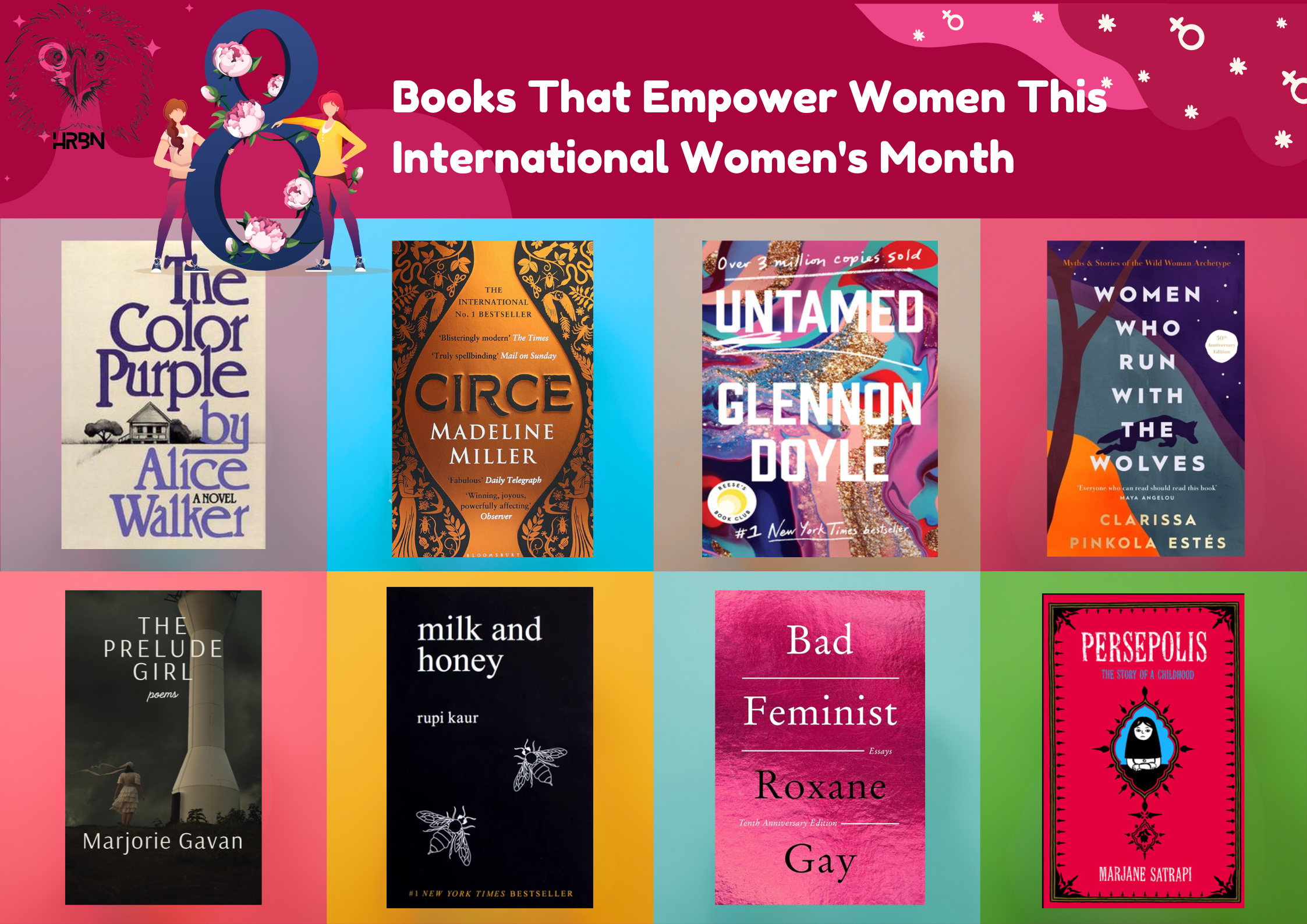
March is International Women's Month, and March 8 marks International Women's Day—a global celebration of women's social, economic, cultural, and political achievements that dates back to the early 20th century labor movements. This year's United Nations theme, "Rights. Justice. Action. For ALL Women and Girls," calls attention to the fact that women still hold only 64 percent of the legal rights that men hold worldwide.
What better way to honor this month than by diving into books that speak to the struggles, triumphs, and inner lives of women? We've gathered eight books—representing fiction, non-fiction, poetry, essays, and graphic memoir—that challenge, inspire, and empower. Whether you're searching for your wild instincts, reclaiming your agency, or simply looking for stories that remind you of your strength, there's something here for you.
1. The Color Purple by Alice Walker
Alice Walker's 1982 epistolary novel follows Celie, a young African American woman in early 20th-century rural Georgia, who endures abuse, separation from her sister Nettie, and a loveless marriage to a man she calls only "Mister." Through letters addressed to God and eventually to Nettie, Celie documents her journey from silent suffering to self-realization. The novel broke ground for its unflinching portrayal of domestic abuse, sexual violence, and the power of sisterhood, winning both the Pulitzer Prize and the National Book Award in 1983—making Walker the first Black woman to win the Pulitzer for fiction. What makes this book enduringly empowering is how Celie's transformation unfolds through relationships with other women: the fierce Sofia, the glamorous Shug Avery, and her long-lost sister. By the novel's end, Celie has built her own business, reclaimed her family home, and found a peace that once seemed impossible. Walker, who grew up in rural Georgia and coined the term "womanism" to describe feminism centered on women of color, wrote a novel that remains as urgent today as it was four decades ago.
2. Circe by Madeline Miller
Madeline Miller's 2018 reimagining of Greek mythology tells the story of Circe, the witch from Homer's Odyssey who famously turned men into pigs. In Miller's hands, Circe becomes more than a minor enchantress—she becomes a fully realized woman navigating a world of gods who dismiss her, mortals who fear her, and a patriarchy as old as time itself. Born as the unloved daughter of the sun god Helios, Circe discovers she has the power of witchcraft and is exiled to the island of Aiaia, where she spends centuries honing her craft and encountering figures from mythology: the craftsman Daedalus, the witch Medea, the hero Odysseus. Reviews praised Miller for casting a "feminist light" on ancient tales, illuminating details previously overlooked. The novel tackles themes of isolation, transformation, and the kind of power that must be earned rather than inherited. Circe's story resonates because she starts as someone mocked and marginalized, yet becomes a woman who chooses her own destiny. Miller, who holds degrees in Classics from Brown University, spent ten years on her debut novel The Song of Achilles before giving Circe the voice she never had.
3. Untamed by Glennon Doyle
Glennon Doyle's 2020 memoir opens with a scene at a zoo, where she watches a captive cheetah and recognizes something of herself—a wild creature trained to perform, to please, to forget her own instincts. That recognition catalyzed Doyle's decision to stop abandoning herself in favor of others' expectations. The book chronicles her divorce from her husband, her falling in love with soccer star Abby Wambach, and her journey toward what she calls becoming "untamed." People magazine dubbed Doyle the "patron saint of female empowerment," noting how she inspires women to listen to their intuition and break free of what cages them. Untamed addresses motherhood, sexuality, addiction recovery, body image, and the cultural conditioning that teaches women to be "good" rather than free. Doyle's prose is both forceful and tender, and the book became a Reese's Book Club selection that sold over three million copies. She is also the founder of Together Rising, a nonprofit that has distributed millions to women and children in crisis, and hosts the chart-topping podcast "We Can Do Hard Things."
4. Women Who Run with the Wolves by Dr. Clarissa Pinkola Estés
First published in 1992, Dr. Clarissa Pinkola Estés's exploration of the "Wild Woman" archetype spent 145 weeks on The New York Times bestseller list—a record at the time. The book weaves together fairy tales, myths, and folk stories from cultures around the world, analyzing them through the lens of Jungian psychology to help women reconnect with their instinctual, creative, and knowing nature. Estés, a Jungian psychoanalyst and cantadora (keeper of stories) in the Hispanic tradition, argues that society's attempt to "civilize" women has muffled the deep, life-giving messages of their souls. Through stories like "La Loba" (the wolf woman who sings bones back to life) and "Bluebeard" (a cautionary tale about the predator), she offers what Maya Angelou called "a gift that shows the reader how glorious it is to be daring, to be caring, and to be women." This is not a quick read—it's nearly 500 pages and dense with symbolism—but readers return to it again and again as a kind of spiritual medicine cabinet for the feminine psyche.
5. The Prelude Girl by Marjorie Gavan
Sometimes the most empowering act is naming what happened to you and refusing to let it define you. Marjorie Gavan's debut poetry collection, The Prelude Girl, does exactly that. The title comes from a painful realization: that the speaker had been a "prelude" in another person's love story—a placeholder, a before-the-main-event—rather than the main character of her own life. But Gavan flips the script. As she has said, "Prelude Girl is something I can call myself to reclaim my agency." The collection explores romantic disappointment, toxic friendships, and the quiet devastation of being marginalized in someone else's narrative. Gavan's poetry features sophisticated vocabulary and extended metaphors—vessels and droughts, red threads and margins—that reward close reading. One poem, "In the Margins," addresses the experience of unfriending a toxic presence: someone who constantly complained, made the same mistakes, and never listened. The controlled emotional register throughout the collection never tips into melodrama; instead, it offers the kind of dignified reckoning that empowers readers to examine their own relationships. Gavan, a Manila-based writer, is also the author of the blog Coffeehan and is currently working on her debut novel. Full disclosure: The Prelude Girl is published by Haribon Publishing, and we are proud to include it on this list. It is available on Amazon and Barnes & Noble. You can read more about Gavan's journey in our three-part series "Every Story Has a Prelude."
6. Milk and Honey by Rupi Kaur
Rupi Kaur self-published Milk and Honey in 2014 as a 21-year-old university student, designing and illustrating the collection herself. It went on to sell over three million copies and spend 165 weeks on The New York Times bestseller list. The book is divided into four chapters—"the hurting," "the loving," "the breaking," and "the healing"—and addresses sexual assault, abuse, love, loss, and femininity in spare, accessible verse. Kaur, who was born in India and raised in Canada, writes in lowercase and uses minimal punctuation as a tribute to Punjabi, her first language. The final section, "the healing," became a touchstone for readers seeking permission to embrace who they are, regardless of what they have endured. Critics have called the collection "a vital read" for its feminist themes and its courage in naming trauma. The title itself was inspired by a 2012 poem Kaur wrote about Sikh widows who survived the 1984 Sikh genocide—a metaphor for resilience passed down through generations. Kaur has since published additional collections and hosts a live show on Amazon Prime, but Milk and Honey remains her signature work.
7. Bad Feminist by Roxane Gay
In her 2014 essay collection, Roxane Gay announces up front that she is a "bad feminist"—someone who loves pink, reads Vogue without irony, and doesn't always live up to the impossible standards of what she calls "essential feminism." That confession becomes the book's liberating thesis: feminism does not require perfection. Across 38 essays, Gay engages with pop culture (Girls, Django Unchained, The Hunger Games), her own experiences as a Haitian American woman, and hot-button issues like reproductive rights and rape culture. The Boston Review praised her as "one of the most astute critics writing today," while Time magazine noted how she shows "what it's like to move through the world as a woman." Gay, who holds the Gloria Steinem Endowed Chair at Rutgers University and writes the "Work Friend" column for The New York Times, has a gift for making the political personal and vice versa. Her essay "What We Hunger For" about surviving sexual violence remains devastating, while her piece on competitive Scrabble tournaments is laugh-out-loud funny. Bad Feminist gives readers permission to contain contradictions—to be flawed and feminist, complicated and committed.
8. Persepolis by Marjane Satrapi
Marjane Satrapi's graphic memoir, originally published in France between 2000 and 2003, tells the story of her childhood in Tehran during the Islamic Revolution and her adolescence in Europe. The stark black-and-white illustrations—often compared to Ludwig Bemelmans's Madeline for their deceptive simplicity—depict a girl who dreams of becoming a prophet, bargains for Michael Jackson buttons on the black market, and watches in horror as family friends are imprisoned or executed. The New York Times named it one of the 50 best memoirs of the past 50 years and one of the 100 best books of the 21st century. What makes Persepolis a feminist work is its unflinching honesty: Satrapi shows herself as flawed, rebellious, self-destructive, and brilliant. Her grandmother's advice—"Always keep your dignity and be true to yourself"—becomes the book's backbone. Satrapi, who now lives in Paris and recently edited the anthology Woman, Life, Freedom about Iran's recent women's protests, has said that girlhood itself becomes an act of rebellion in a society where obedience is demanded. The 2007 animated film adaptation, which she co-directed, was nominated for an Academy Award.
Your Story Begins Now
These eight books span decades, continents, and genres, but they share a common thread: the insistence that women's stories matter. Whether you find yourself in Celie's letters to God, Circe's island exile, or Marji's defiant punk jacket, these pages offer something more than entertainment. They offer recognition, validation, and the reminder that transformation is always possible—even when the world insists you stay small.
This International Women's Month, pick up one of these books. Underline the passages that speak to you. Share them with the women in your life. Because empowerment is all about recognizing your own.