

Salmon, Kelp, Bonito Flakes: How Gege Akutami Built a Fan Favorite Out of a Character Who Cannot Speak
Toge Inumaki has almost no dialogue and almost no page time. He placed fourth in a popularity poll — and his own author said he could not understand why. The answer is a technique any writer can use.
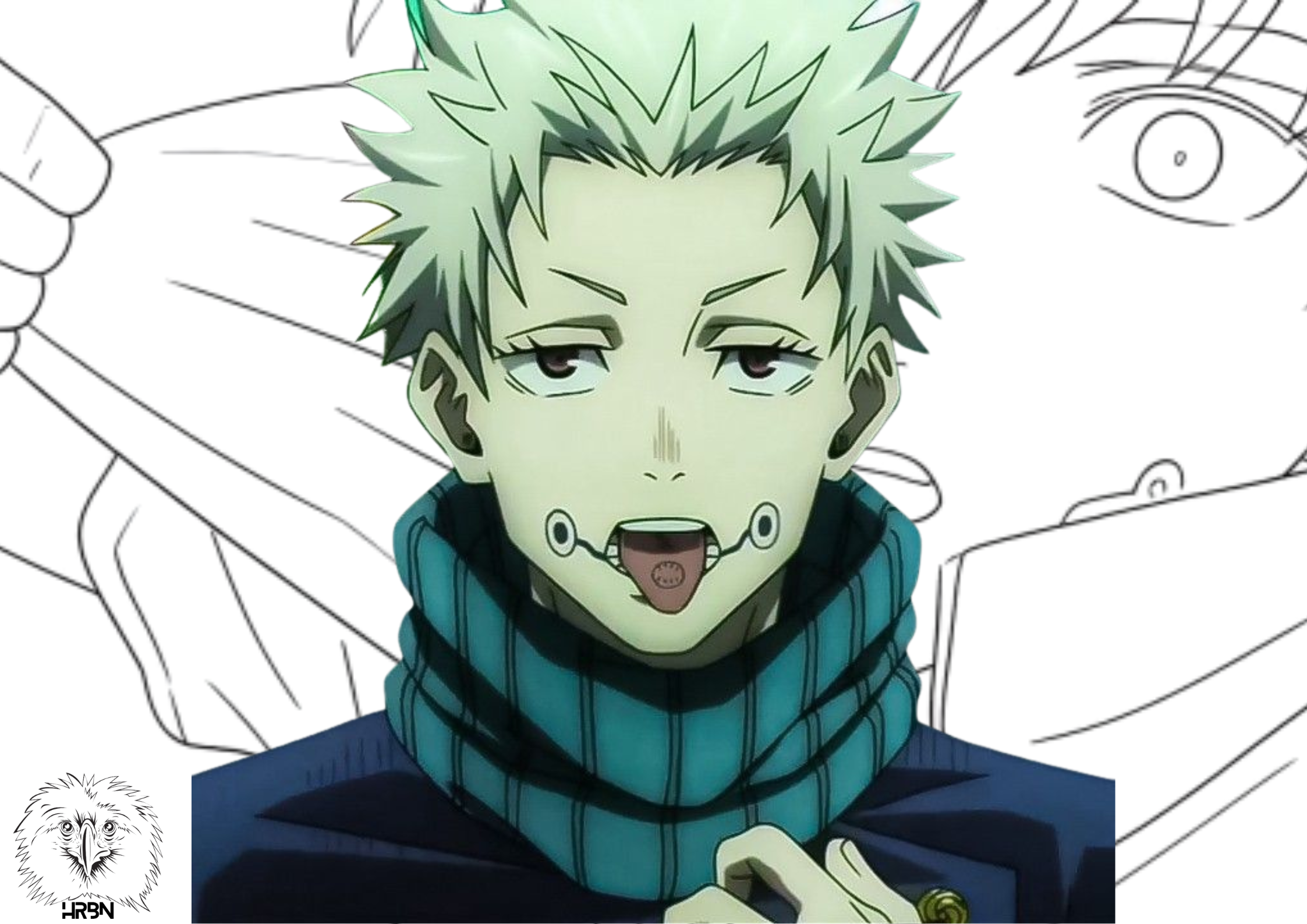
SPOILER WARNING: This article is spoiler-heavy. It discusses events through the Kyoto Goodwill Event and Shibuya Incident arcs of Jujutsu Kaisen, with light reference to the Culling Game. If you are still early in the anime, bookmark this and come back.
Gege Akutami has been publicly baffled by one of his own characters.
When Toge Inumaki placed eighth in a Valentine's Day popularity poll in 2020, Akutami's published comment amounted to bewilderment that a character he had barely explored could rank that high. When Toge placed eighth again the following year, the comment was that the character hardly ever appears (Dexerto). In the main series polls he did better still: fourth place in the first one, ahead of Kento Nanami, Nobara Kugisaki, and Yuta Okkotsu. By the third poll he took 2,459 votes — more than Maki Zenin, more than Choso (Sportskeeda).
This is a character with almost no dialogue.
Not reserved. Not a man of few words. In ordinary conversation Toge Inumaki's entire vocabulary is rice ball ingredients — salmon, bonito flakes, kelp, mustard leaf, salmon roe, spicy cod roe, tuna mayo. That is the lexicon. He does not have a second register he switches into when something important happens. For the overwhelming majority of his appearances, those words are all he has.
The reason is his inherited technique. As a descendant of the Inumaki clan, Toge carriesCursed Speech. His words are reinforced with cursed energy, and anyone who hears them is compelled to act or be acted upon accordingly. He cannot switch it off. Ordinary conversation is, therefore, a hazard to everyone in earshot, so he restricts himself to words that carry no command in them.
Which leaves a writing problem that most novelists eventually run into in some milder form. The child too young to name what happened to her. The witness who will not talk. The character whose language the viewpoint character does not share. The one who is dying, or terrified, or too proud, or under orders. When a character cannot explain themselves, most writers do one of two things: quietly let them explain anyway, or leave them blank on the page.
Akutami did neither, and the machinery he used instead is entirely portable.
The Fandom Cannot Agree on What He Says. It Does Not Matter.
Start with the oddest fact about Toge, because it points straight at the mechanism.
There is no stable dictionary for his vocabulary. TheJujutsu Kaisen Wiki glosses salmon as affirmation, bonito flakes as negation, and leaf mustard as a check on someone's wellbeing. Other outlets assign tuna to negation, or read salmon roe as surprise where another reads it as an expletive (Epicstream). Akutami has said that a good deal of it is simply gibberish (Twinfinite).
If the words carried the meaning, this would be a solvable problem. Someone would publish the correct table and the argument would end. Instead, the argument has run for years while readers continue to follow his scenes without difficulty.
That gap between untranslatable vocabulary and effortless comprehension is the whole craft lesson. The meaning is not in the words. It never was.
The Technique Is Characterization by Reply
The label is a coinage rather than an established term, but the mechanism behind it is well documented. Toge is not built out of what he says. He is built out of what other people say back.
Four things are doing the work, and they can be lifted individually.
1. The Response Carries the Line
When Toge says "salmon," Panda answers as though a specific sentence has been spoken. Maki reacts to a full opinion. Yuta responds to a question. The reader never receives Toge's line — the reader receives its echo, and reconstructs the original from the shape of the reply.
This is enormously efficient. A reply can carry content, tone, and the relationship between two people at once, in a fraction of the space a full exchange would need. Most writers already own this tool and use it only for comedy. It will carry far more weight than that.
2. Placement Supplies the Meaning
The same syllable does different work depending on where it lands. "Salmon" before a mission and "salmon" over a body are not the same utterance, and no reader confuses them. Toge is a sustained demonstration that dialogue does not carry meaning on its own. Context does, and context is doing far more of it than writers usually credit.
The practical version: most dialogue is over-written because the writer does not trust the surrounding scene to carry it. Toge is proof of how much can be stripped before comprehension actually breaks.
3. The Body Does the Semantics
Toge's high collar, half-lidded eyes, and small physical gestures carry the load that words would otherwise carry. Akutami designed a character whose face is deliberately half-hidden, which forces the remaining signals — the eyes, the tilt of the head, the hand — to do more, and makes the reader watch them more closely.
4. Comprehension Is Earned Inside the Story
This is the detail that separates Toge from a gimmick. According to the official fanbook, it takes roughly half a year to understand him fully (Jujutsu Kaisen Wiki). His friends are not humoring him, and they are not magically fluent. They learned him, over months, the way you learn anyone.
So the comprehension the reader experiences is mirrored by comprehension inside the fiction, and both took time. When Noritoshi Kamo is visibly confused about how the Tokyo students follow any of this, the story is quietly telling the reader that understanding Toge is an achievement, not a given.
There is a name in literary theory for what the reader is doing in all four cases. Wolfgang Iser's reader-response work centers onblanks — indeterminate spaces in a text that readers fill through active participation, and which produce engagement precisely because they are unfilled. Toge is a walking blank. The reason readers feel close to him is that they have been doing the work of understanding him since his first appearance.
Cursed Speech: Toge Inumaki's Powers and Abilities, Explained
Cursed Speech (jugon) is an inherited technique of the Inumaki family. It reinforces the user's spoken words with cursed energy, compelling anyone who hears them to act or be acted upon according to the command.
The Snake Eyes and Fangs Seal
Execution requires a cursed tool bearing a particular set of seals. In Toge's case the seals are markings on his cheeks and tongue — he is the tool. The same seals appear on the Serpent Eyes and Fang cursed tool the Inumaki family produced, which is how Yuta Okkotsu is able to use a copied version of the technique through a summoned megaphone.
Command Range
Both living beings and objects can be targeted. Documented commands run from restraint and redirection — telling an opponent not to move, or to run away — through to destructive orders such as being crushed or blasted away. The strength of the compulsion scales with the skill of the user rather than being fixed by the wording.
Versatility
Because the technique is built on language rather than on a specific element or object, it has no natural counter-type. Anyone who does not know how to defend against it is effectively helpless, which is unusual in a power system otherwise full of matchup logic.
Demonstrated Grade
As a first-year Grade 2 sorcerer, Toge's Cursed Speech was already sufficient to exorcise a large group of low-grade cursed spirits along with a semi-grade 1 curse. By the main series he is a semi-grade 1 sorcerer himself and is treated by his peers as one of the strongest students in the school.
But Cursed Speech Has Limits — and They Are the Character
In most power systems, a limitation is a balance mechanic. Here, it is the entire personality. Every restriction on Cursed Speech shows up somewhere in who Toge is.
1. It Damages the User
Overuse takes a physical toll that scales with the strength of the command. Symptoms run from a sore throat through coughing blood to losing the ability to speak entirely, and the technique can backfire outright (Jujutsu Kaisen Wiki). Toge carries cough syrup to extend how long he can keep going. During the Kyoto Goodwill Event, fighting Hanami alongside Megumi Fushiguro and Noritoshi Kamo, his throat gives out mid-engagement, and Hanami immediately capitalizes.
2. It Can Be Blocked
A sorcerer who knows what is coming can manipulate the flow of cursed energy to the part of the brain governing ear function, preventing the command from registering at all. Against an informed opponent, the most versatile technique in the school stops working.
3. It Costs Him Ordinary Life
This is the limitation that matters most, and the series states it plainly: cursed speech users tend to become reserved people who communicate in code, because they cannot converse naturally with anyone. The technique does not merely restrict Toge in combat. It has shaped how he exists in a room.
Note what Akutami gets out of that. The drawback is not a number on a stat sheet. It generates the character's demeanor, his relationships, his humor, and the reason readers find him moving. If a writer can build a limitation that produces personality rather than just capping power, the limitation will pay for itself many times over.
Why Most Quirky-Speech Characters Fail
Fiction is full of characters with a verbal gimmick, and most of them are unbearable. Toge is not, and the difference comes down to three tests.
Reason
The constraint has an airtight in-world cause. Toge does not speak in rice ball ingredients because it is charming. He does it because ordinary speech physically compels everyone who hears it. Remove the constraint and people get hurt.
Cost
It costs him something the reader can see. He cannot make small talk. He cannot argue, comfort at length, or explain himself when misunderstood. He is a seventeen-year-old who has never had a normal conversation.
Ethic
He chooses it, and he chooses it for other people. The vocabulary is not a symptom he suffers; it is a daily discipline he performs so that nobody near him gets hurt. Every scene in which he says nothing is a scene in which he is protecting someone.
Justify the Rule. Do Not Justify the Flavor.
Akutami never explains why the safe words are specifically onigiri ingredients. The wiki notes the point as unexplained; fans have argued about it on forums for years and generally concluded there is no in-story reason (Jujutsu Kaisen Wiki forum). Various origin stories circulate online, but none of them hold up against the source material.
And it does not matter even slightly. Nobody's engagement with Toge depends on knowing why he picked rice balls over, say, train stations.
Readers require you to justify the rule — why this character cannot speak freely, and what happens if he does. Readers do not require you to justify the flavor. Most failed gimmick characters have this backward: they have an elaborate backstory explaining the quirk, and no real constraint underneath it. The quirk is decoration. The rule is load-bearing.
Plain Speech Is Either a Weapon or an Act of Trust
Because his ordinary vocabulary is so restricted, every real word Toge speaks is an event — and the story only ever spends them two ways.
The first is combat. When he speaks plainly on a battlefield, the words are ordnance, and the reader knows the situation has become serious because he was willing to damage his own throat to change it.
The second is rarer and better. He has spoken near-commands to Yuta as warnings, but only when he was confident Yuta could withstand the effect (Twinfinite). Speaking normally to someone is, for Toge, a statement that he believes they can survive him.
There is no third category. He does not get to use language casually, which means the reader has been trained, over dozens of chapters, to read any plain sentence from him as either violence or intimacy. That is an extraordinary amount of loaded meaning to attach to the simple act of a character talking, and it was built entirely out of withholding.
The Shibuya Incident closes the loop with a cruelty that is almost too neat. Toge is caught inside the radius of Sukuna's Malevolent Shrine and loses an arm (Sportskeeda). He was not fighting. He was guiding civilians to safety, and it happens off-page (Dexerto). The most consequential thing that ever happens to him occurs while he is quietly protecting people, out of frame, without a word — which is a fair summary of his entire characterization.
What Readers Are Still Arguing About
The most telling piece of evidence for how well this works is that the author did not fully predict it. Akutami's poll comments read as genuine confusion at a character he considers underwritten ranking above characters he has spent arcs developing (Dexerto).
The fandom has its own theories. One reading credits the design, the powerset, and the food-based dialogue (The Escapist). Another points out that readers know almost nothing about his backstory beyond a few implications, and that the mystery is itself the appeal (CBR). Jujutsu Kaisen 0 gets cited constantly, because it contains the sequence where Toge shows Yuta kindness during his worst period at the school without speaking to him at all.
All three explanations are downstream of the same thing. A character you had to work to understand feels like a character you know personally. The effort is the attachment.
It is worth noting the failure mode, too. Since Shibuya, Toge has barely appeared, and a technique that runs on other characters' responses stops functioning the moment those characters are not in the room with him. A blank only works while someone is filling it. Take him off the page entirely, and the machinery goes quiet — which may be part of why fan discussion of him has shifted from what he might do next to what he was never given.
How to Write a Character Who Cannot Explain Themselves
Five things transfer directly.
1. Write the Reply, Not the Line.
Give the reader the response and let them reconstruct what prompted it. This works far beyond mute or restricted characters. It is one of the fastest ways to compress an exchange without losing any of its content.
2. Let Placement Do the Translating.
The same words in a different scene are different words. Before adding a clarifying line of dialogue, check whether the scene around it has already said the thing.
3. Make Understanding Cost Something Inside the Story.
If other characters comprehend your difficult character instantly, the difficulty is fake. Somebody should have had to learn them, and it should have taken a while.
4. Test the Constraint for Reason, Cost, and Ethic.
Why can't they speak plainly? What does the restriction take from them? And is there anyone they are protecting by keeping it? A constraint that fails all three is a verbal tic. One that passes all three is a character.
5. Spend Plain Speech Like Money.
If a character rarely speaks directly, every direct sentence should cost them something or mean something. Decide in advance what the categories are, and never let a plain line fall outside them.
Credit Where It Belongs
All of this isGege Akutami's construction, and the interesting thing is how little of it looks like effort on the page. There is no chapter devoted to establishing Toge. There is no flashback explaining him. He was given a hard rule, a visible cost, and a room full of people who answer him — and then he was mostly left alone.
The result placed fourth in a readers' poll and confused the man who drew him.
A character who cannot speak is not a character with a hole in him. He is a character the reader has to lean toward, and readers become attached to whatever they have had to work for. Akutami's real discipline was resisting the urge to help.