

The Words That Push Readers Away
How Filter Words Create Distance Between Your Story and Your Audience
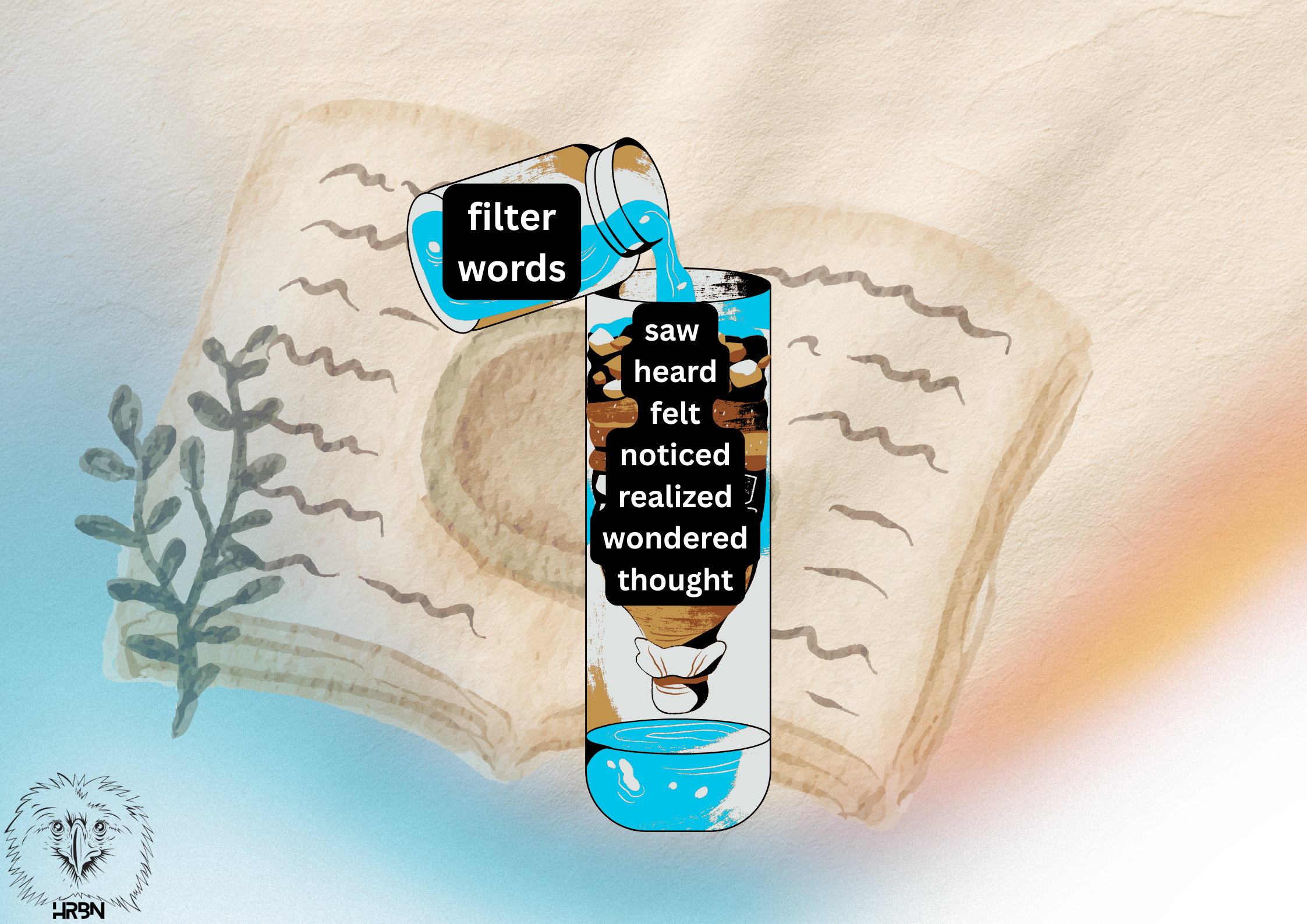
Something strange happens when you write "she noticed the room was cold" instead of "the room was cold." On the surface, both sentences communicate the same information. But one of them pulls readers into the experience while the other holds them at arm's length, reminding them that they're watching a character rather than being that character. The culprit is a category of words that craft teachers call "filter words"—and once you learn to spot them, you'll find them lurking throughout your drafts, quietly sabotaging your prose.
Janet Burroway, author of Writing Fiction: A Guide to Narrative Craft—the most widely used creative writing textbook in America—coined the term to describe words like saw, heard, felt, noticed, realized, wondered, and thought. These verbs filter a character's experience through an extra layer of narration, and Burroway warns that they create a specific problem: "When you step back and ask readers to step back and observe the observer—to look at rather than through the character—you start to tell-not-show and rip us briefly out of the scene."
John Gardner, novelist and author of The Art of Fiction, described the same phenomenon as "the needless filtering of the image through some observing consciousness." He offered a pointed comparison: "The amateur writes: 'Turning, she noticed two snakes fighting in among the rocks.' Compare: 'She turned. In among the rocks, two snakes were fighting.'" The second version drops us directly into the scene. The first reminds us we're reading about someone else's experience.
The concept connects to what craft teachers call "psychic distance"—how close or far the reader feels from the character's consciousness. When you write "he saw the door swing open," there's a subtle but real gap between reader and action. The reader watches the character watch the door. But "the door swung open" eliminates that gap entirely. The reader is there when it happens.
Consider a scene where your protagonist enters a suspicious house. You might draft something like: "She heard floorboards creak upstairs. She felt her heart rate spike. She noticed a trail of muddy footprints leading toward the kitchen." Each sentence tells us something about her perception. But watch what happens when you strip out the filters: "Floorboards creaked upstairs. Her heart rate spiked. A trail of muddy footprints led toward the kitchen." The information is identical, but the experience is transformed. We're no longer watching her from outside—we're inside her skin, hearing what she hears, feeling what she feels.
Kelley J.P. Lindberg, writing for Rocky Mountain Fiction Writers, calls filter words "throat clearing" phrases—moments when the author "takes a moment to hem and haw before getting around to the real action in the sentence." That's a useful way to think about them. Filter words don't add meaning; they delay it. They're verbal wind-up before the pitch.
Novelist Emma Darwin, on her craft blog This Itch of Writing, distinguishes between two types of filter words. There are "physical filter words"—verbs of perception like see, hear, watch, look, feel, smell, taste, and notice—and "thinking filter words" like wonder, realize, seem, think, remember, recall, and decide. Both create the same problem: they insert the narrator's voice between reader and experience, acting as—in Darwin's phrase—"context and explanation" that we often don't need.
All of this might sound like yet another rule to obsess over during first drafts. It isn't. Gardner himself acknowledged that "no laws are absolute in fiction," and Burroway explicitly calls filtering "a common fault and often difficult to recognize" precisely because it happens naturally during drafting. When you're working out a scene, you're thinking through your character's perceptions: she sees this, he hears that, she realizes something. Those phrases are scaffolding—useful for getting the structure up, but meant to come down once the building is finished.
There are also moments when filter words serve a purpose. If the act of noticing is itself significant—if a character's attention shifts in a meaningful way, if they're struggling to understand what they're perceiving—then naming that perception can earn its place. "He looked very, very closely at the cuff and saw spots of blood" lands differently than "spots of blood dotted the cuff" because the deliberate looking matters. Darwin notes that the key is making filtering available as a tool you control, rather than a habit you don't notice.
For revision, the fix is mechanical. Use your word processor's Find function to search for common filter words: saw, heard, felt, noticed, realized, wondered, thought, remembered, seemed, watched, looked, decided. Highlight them. Then, for each instance, ask two questions. First: does removing this word change the meaning? If you cut "she noticed" from "she noticed the car was gone" and write "the car was gone," does the reader lose anything important? Usually not—if the scene is written from her perspective, we already know she's the one perceiving it. Second: does removing this word improve the immediacy? Read both versions aloud. If the unfiltered version puts you closer to the action, make the cut.
You won't eliminate every filter word, nor should you try. But you'll likely find that most of them are doing nothing except standing between your reader and your story—polite little bouncers keeping the audience at a safe remove. Once you start noticing them, you'll wonder how you ever missed them. And your prose will be tighter, more vivid, and more immediate for letting readers look through your characters rather than at them.