

The Same Curse: How Hiro Mashima Built Mavis Vermillion and Her Greatest Enemy Out of One Idea
Fairy Tail's founder and the Black Wizard Zeref are the great love of each other's lives. They also carry the identical affliction — and nearly every power Mavis has is a restatement of it.
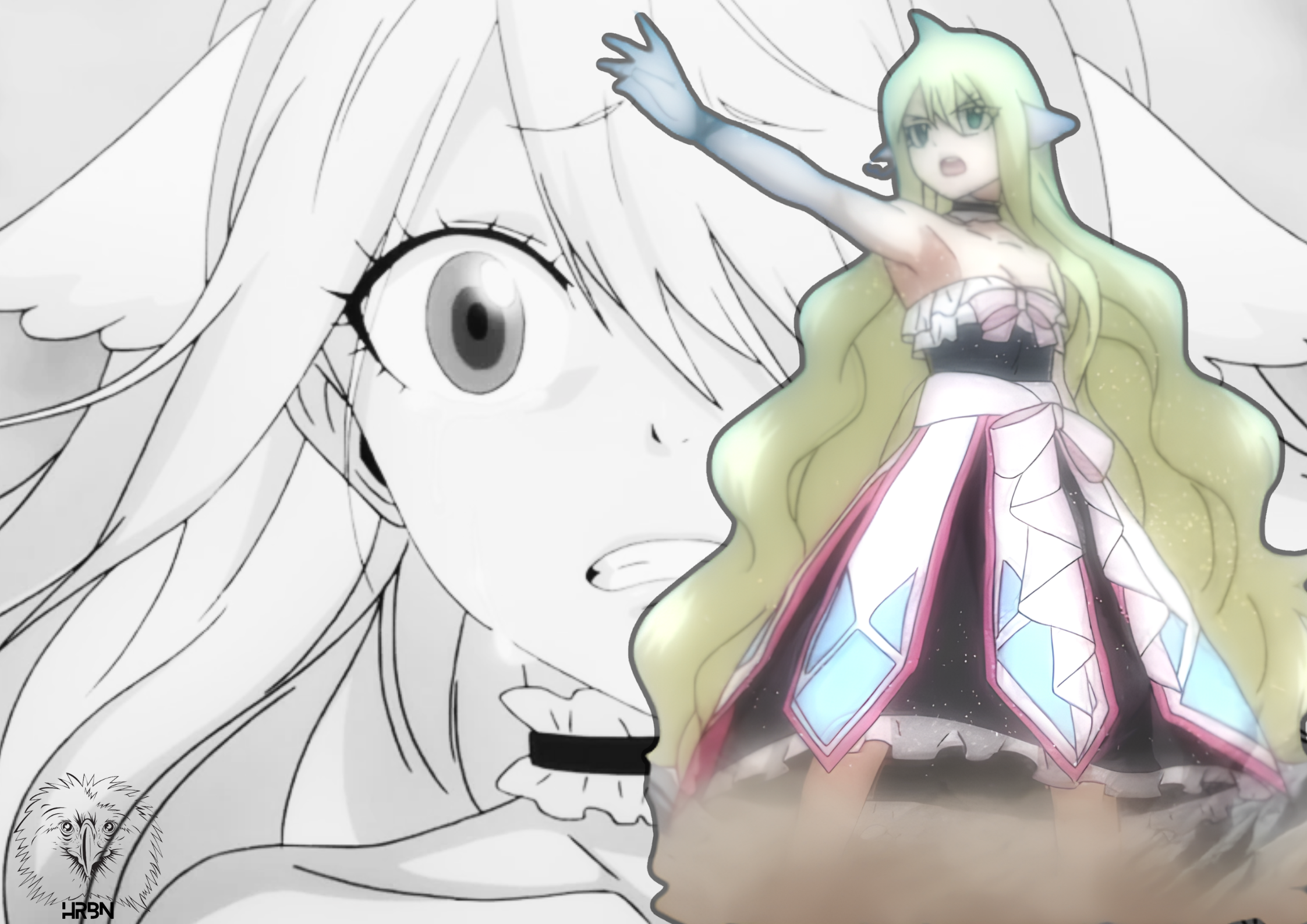
SPOILER WARNING: This article is spoiler-heavy and discusses Fairy Tail through its final chapter, including Fairy Tail Zero, the Tenrou Island arc, and the Alvarez Empire arc. If you have not finished the series, bookmark this and come back.
Mavis Vermillion founded Fairy Tail. Zeref Dragneel spends most of the series trying to take it apart. They are also the great love of each other's lives, and the first time they act on it, she dies in his arms.
That outcome is not a tragic accident of circumstance. It is the direct, mechanical result of a decision Hiro Mashima made about how to build the two of them, and once that decision is visible, most of what makes Mavis compelling stops looking like charm and starts looking like architecture.
The decision was this: rather than making the founder and the destroyer opposites, Mashima gave them the same problem.
The Technique Is a Shared Premise
Both Mavis and Zeref carry the Curse of Ankhseram, sometimes called the contradictory curse. Its rule is simple and vicious: the more you value life, the more life you take. Care about someone and they die. Zeref spells it out for Mavis in the forest outside Magnolia, and she does not believe him until Yuri Dreyar's wife dies in the guild hall moments after Mavis holds her hand (Fairy Tail Wiki).
Neither of them asked for it. Neither can remove it. Neither can die of it — the curse grants an immortality that makes escape impossible, which Mavis discovers when six months without food leaves her thin and wretched and entirely alive.
So the two most powerful mages in the setting share an identical predicament. What separates them is not the problem. It is the conclusion each draws from it.
Zeref concludes that if affection is lethal, the answer is to stop feeling it and eventually to stop the world that requires it. He builds an empire, plans a war, and spends four centuries looking for a way to die. Mavis concludes that if she personally cannot hold anything close, she will build a structure that holds people for her. That structure is Fairy Tail — a guild explicitly organized around bonds, founded by a woman whose bonds kill.
Same premise. Opposite answer. That is the whole engine.
Where This Sits Against the Standard Advice
The familiar version of this idea in writing craft is the Shadow archetype, the antagonist-as-dark-mirror that Christopher Vogler popularized for writers in The Writer's Journey. In that model, the villain embodies the hero's repressed or rejected potential — what they could become if they let go.
Mashima pushes past it in two ways worth stealing.
First, the mirror runs both directions. Zeref is what Mavis becomes if she gives up, and Mavis is what Zeref could have been if he had found one person before the centuries hardened him. Neither is the primary, and neither is the reflection.
Second, and more unusually, their shared condition draws them together rather than sets them at odds. They are the only two people alive who understand each other's specific loneliness. The relationship is romantic for a reason internal to the design: nobody else qualifies.
And because the curse punishes love specifically, the one thing they share is the one thing that forbids contact between them. The obstacle is not a family feud, a rival faction, or a misunderstanding. It is the metaphysics of their own condition. A writer who arranges a relationship this way never has to manufacture a reason to keep two characters apart, because the reason is already load-bearing.
The Proof Is in a Single Spell
If the shared-premise reading were merely a nice interpretation, it would not show up in the magic system. It does.
Zeref teaches Mavis a Black Magic called Law so she can defend her friends. She casts it incomplete, to save Yuri from the Tenrou Jade, and pays for it: her body stops growing at thirteen, and she unknowingly takes on Ankhseram. The spell takes ten years to master properly, and cast early its price is unpredictable (Fairy Tail Wiki).
Years later Mavis reworks that same spell, strips out the cost to the caster, and the result becomes Fairy Law — the first of the Three Great Fairy Magics and the signature spell of her guild.
So the holiest magic in Fairy Tail is the Black Wizard's black magic with the price removed. That is Mavis's entire answer to the curse, compressed into one artifact.
Look at what Fairy Law actually does, too. It harms whoever the caster perceives in their heart as an enemy and leaves everyone else untouched. The spell reads the caster's affections and sorts the world accordingly — the exact faculty the curse exists to punish. Mavis took the thing that made her lethal and turned it into a targeting system that spares the people she loves.
Her First Magic Was a Refusal to Let Go
The shared curse is the visible half of the design. The other half is older and quieter, and it starts before Zeref appears at all.
In X679, the Blue Skull guild raids Mavis's home. She is a child working off her dead parents' debts. During the attack she pulls another girl, Zera, out of the rubble and carries her toward the forest. Zera asks if they can be friends. Mavis says yes, turns around, and Zera is dead on the ground.
Mavis then spends seven years alone on Tenrou Island — except she does not experience it as alone. Zera is with her the entire time: talking, scolding her for going barefoot, cleaning out the library with her. Mavis teaches herself Illusion Magic from books during those years.
She does not know that Zera is one of them.
The reveal comes from Yuri, who cannot see the girl Mavis keeps talking to. Zera confirms it herself: she died the day of the raid, and everything since has been Mavis's magic. She begins fading as soon as Mavis understands. And in the moment Mavis finally accepts it, Yuri can see Zera too — long enough for Zera to ask him to look after her.
This is the detail that makes the whole character cohere. Mavis's first and longest-running spell was grief. Her signature power and her deepest wound are the same object, and she carried it for seven years without knowing.
For writers, that is the higher-value version of giving a character an ability. Not what they can do, but what the ability is made of. A power that is simply granted is a tool. A power that is generated by the character's worst moment is characterization that keeps paying out every time it appears on the page.
And Then She Becomes Zera
Here is where the construction becomes genuinely remarkable.
After Mavis dies, Precht encases her body in a Lacrima in the guild basement, because he can still sense magic in her heart and cannot accept the loss. She remains there, comatose, for roughly a century. Meanwhile her consciousness walks around Magnolia as a Thought Projection — cheering at the Grand Magic Games, advising Makarov, visiting a water park.
Only people bearing the Fairy Tail mark can see or hear her.
Which is precisely what Zera was. A dead girl, kept present by someone who could not let go, visible only to the person holding on. Mavis spent her childhood sustaining an illusion of a friend she had lost. She spends her afterlife as one, sustained by a guild that will not release her.
Mashima then closes the loop on purpose. During the Alvarez war, Zera briefly returns — heard by Fairy Tail members as a voice — and vanishes for the last time in front of Mavis. The two friends say goodbye a second time, a hundred years after the first.
The technique here is thematic rhyme: the same shape recurring at different scales, so that late material reaches back and re-colors early material. Mashima does not explain the parallel. He builds it and leaves it, which is why it lands as recognition rather than as a lecture.
Mavis Vermillion's Powers and Abilities, Explained
Mavis is unusual among major Fairy Tail figures in that she is not a fighter. Her abilities cluster around perception, protection, and preservation — and most of them restate the same idea in different terms.
Illusion Magic
Self-taught on Tenrou Island and her core discipline. Her illusions are detailed enough to pass for real, and she uses them mainly to intimidate rather than to injure. Named applications include Heavenly Wolf, an enormous wolf with dark flame markings; Tenrou Soldier, an entire army of armored knights; and Guardian Eagle, a vast winged creature. She also uses illusions tactically — conjuring a shower of gold coins to lure a possessed Yuri into position.
Law
The Black Magic Zeref taught her. It releases a burst of light that inflicts heavy damage on the caster's target, and it was strong enough to break the Tenrou Jade's hold. Mastery reportedly takes ten years; casting it incomplete carries an unpredictable price.
Fairy Law
The first of the Three Great Fairy Magics, derived by Mavis from Law with its side effect on the caster removed. It damages only those the caster perceives in their heart as enemies, leaving allies and bystanders unharmed.
Fairy Glitter
A Great Fairy Magic that rivals Fairy Law: a merciless radiance that rejects the presence of any foe, described as concentrating the light of the sun, moon, and stars. Mavis lends it to Cana Alberona rather than wielding it herself — twice.
Fairy Sphere
An absolute defense spell powered by converting the guild members' bonds and faith into magic. It withstood Acnologia's roar and shielded everyone on Tenrou Island, but it also functions as a stasis chamber: those inside do not age, which is why seven years passed outside while the Tenrou team did not.
Thought Projection
The apparition she uses to interact with the world while her body remains in the Lacrima. It flies, walks on water, and can perform ordinary tasks — but only those bearing the Fairy Tail insignia can perceive it.
Telepathy
She can communicate with people within a surrounding area, which is how she coordinates guild-wide strategy during the Alvarez war and how she answers Irene Belserion's taunts across a battlefield.
Ankhseram Black Magic and Immortality
Not an ability she uses but an affliction she carries. It halts aging, prevents death, and kills those she holds dear. Its active manifestation, Death Predation, produces a dark wave that kills everything nearby.
Master Strategist — The Fairy Tactician
Arguably her real power. She memorizes the abilities, fighting styles, and behavioral patterns of opposing teams, runs the scenarios, and issues plans so accurate they resemble precognition. During the Grand Magic Games she calls a 97 percent likelihood that Rufus will act, predicts how Laxus will absorb the attack, and choreographs Fairy Tail's final-day victory from the stands.
Fairy Heart
Worth stating precisely, because it is often described as a spell she casts. It is not. Fairy Heart is what her body became after Precht spent decades running regenerative experiments on a corpse that would not stay dead. Her immortal life force plus his work produced an infinite source of magic power — enough, she estimates, to fire Etherion without pause. Mavis is the reservoir, not the wielder. She spends the Alvarez arc being hunted for it, tortured for it, and eventually strapped to a table while an enchantress tries to extract it.
Where Her Magic Stops
Every one of those abilities has a documented failure point, and the failures are where the character lives.
Illusion Magic can simply be seen through. The Blue Skull guild master looks at her army of knights, recognizes it as false, and dispels it, leaving Mavis exposed in front of people she was trying to protect. Her Thought Projection is not invulnerable either: when Jacob Lessio attacks it, the corresponding damage appears on her real body in the Lacrima.
Law cost her adulthood and gave her the curse. Fairy Sphere saved her guild by removing seven years from their lives. Fairy Glitter she does not use at all — she hands it to someone else. And Fairy Heart, the infinite power everyone wants, does nothing for her except make her the most valuable object on the continent.
Her strategies fail, too, and the series makes a point of it. When Erza faces Kagura instead of Minerva as predicted, Mavis breaks down crying over where her calculations went wrong, and stays upset about it for chapters. She forgets that Dragon Slayers get motion sick and watches an entire aerial counterattack collapse because of it (Fairy Tail Wiki).
This is deliberate and it is instructive. A strategist who is always right is a plot device. The tears after a failed prediction are what convert competence into character, because they show what the competence is for. Mavis is not calculating to demonstrate intelligence. She is calculating because she believes any miss gets someone killed — which, given what she carries, is not an unreasonable thing for her to believe.
What Readers Still Argue About
Mavis was not originally going to be any of this. Mashima's initial concept for Fairy Tail's first master was an elderly man; he redesigned the character as a girl after learning that Mavis is a female name, and has said he wanted her being a small child to land as unexpected (Fairy Tail Wiki).
Her expanded role in the story came afterward, driven by reader response. In Mashima's own informal ranking of characters whose popularity defied his expectations, Mavis placed first.
The relationship itself remains the most argued-over element. The pairing has its own extensive fan documentation, and the central question — whether the ending is a tragedy or a resolution — has never settled (Fairy Tail Couples Wiki).
The text supports both readings. In their final confrontation, Mavis tells Zeref that he ruined her life and made her friends suffer, and that she loves him anyway, and that the love has grown as strong as the hate (ComicBook.com). She says both things because both are true, and the curse she carries is built out of exactly that kind of contradiction.
Their first kiss killed only her. Their last embrace takes them both — and that is what finally ends the curse, because a contradiction this complete leaves nothing for it to feed on. Makarov, waking afterward, reports having seen a barefoot girl and a black-haired boy playing somewhere, joyfully. In the final chapter the two are living ordinary lives under new names: he writes, she works for a small publishing company.
How to Build an Antagonist Out of Your Hero
Five things transfer directly.
1. Give Them the Same Problem, Not Opposite Goals
Opposing goals produce conflict. A shared predicament with opposing conclusions produces conflict plus meaning, because every scene between them is implicitly an argument about the right way to live. Decide what your protagonist and antagonist both suffer from before you decide what they want.
2. Make the Thing They Share the Thing That Divides Them
If the bond and the barrier are the same object, you never have to invent obstacles. The relationship generates its own resistance, indefinitely, without a single contrived interruption.
3. Build the Power Out of the Wound
Do not assign abilities from a list. Ask what this character could not accept, and let the ability be the shape of that refusal. Illusion magic born from a girl who would not let her friend be dead is worth more than any amount of power-scaling.
4. Let the Same Shape Recur at Different Scales
Rhyme rewards attentive readers without penalizing casual ones. Mavis sustaining Zera and a guild sustaining Mavis are the same event a century apart. Nobody has to notice for the story to work, and noticing makes it better.
5. Let the Competent Character Be Wrong Sometimes
A strategist who never miscalculates is a device for delivering plot. The failure, and the reaction to the failure, is what tells the reader what the competence costs and why the character keeps paying it.
Credit Where It Belongs
All of this is Hiro Mashima's construction, and it is worth noting how much of it was built retroactively. Mavis began as a design Mashima changed on a whim about a name, then grew into the spine of the series because readers responded to her. The curse, the guild, the illusion, the lacrima, and the rhyme between Zera and Mavis were assembled across hundreds of chapters, and they fit.
The lesson underneath is not about curses or magic guilds. It is that a protagonist and an antagonist built from the same material will generate more story, more feeling, and more genuine difficulty than two characters who merely want incompatible things.
Mavis Vermillion founded a guild about bonds because bonds were the one thing she was forbidden to have. Zeref tried to end a world that would not let him be loved. They were never opposites. They were one problem, answered twice.