

The Power of the Short Paragraph
How White Space and Paragraph Breaks Control Pacing and Emphasis
Most writers think about sentences. They worry about word choice, syntax, rhythm. But fewer think about the paragraph as a unit of meaning—a visual and structural tool that controls how readers experience a story. The paragraph is more than just a container for sentences. It's a pacing device. And the short paragraph, used deliberately, is one of the most powerful tools a fiction writer has.
Consider what happens when a sentence stands alone.
It gains weight. The white space around it creates a pause—a beat of silence before and after. The reader's eye lands on it differently than it would if the same sentence were buried in the middle of a longer paragraph. That isolation is emphasis. It says: this matters.
Fred D. White, writing in Writer's Digest, notes that paragraphing in fiction "is more an element of individual style than of grammar." Unlike academic writing, where paragraphs follow structural rules about topic sentences and supporting evidence, fiction paragraphing is rhetorical. It's about effect. White identifies three things paragraphs do in fiction:
They manage content, breaking scenes into digestible units.
They amplify voice, since "how your narrator sounds and thinks affects the rhythm and even the design of the paragraph."
They generate mood, whether "introspective and thoughtful, or hurried and staccato."
The staccato option is where short paragraphs shine. In action sequences, tension scenes, or moments of revelation, shorter paragraphs speed up the reading experience. The eye moves faster. The white space between paragraphs creates a visual rhythm that mirrors urgency.
Janice Hardy, author and writing instructor, explains on Fiction University that paragraph length is a tool for line-level pacing. "Putting the last short sentence into its own paragraph gives it added emphasis," she writes, "causing it to seem more important and ominous." A sentence that might feel like a throwaway detail when attached to a longer paragraph becomes a cliffhanger when it stands alone. The structure itself creates tension.
No one has taken this principle further than James Patterson, whose thrillers are famous for ultra-short chapters—sometimes only two or three pages. In a Fast Company interview, Patterson explained that he borrowed this technique from literary novelists Evan S. Connell and Jerzy Kosinski, whose short chapters created a "colloquial style of storytelling where things really just move along." What Patterson understood—and what thriller writers have since adopted—is that chapter breaks, like paragraph breaks, are pacing tools. Shorter units create momentum. Readers think: "The next chapter is only two pages—I'll keep going."
The same psychology applies at the paragraph level. A page dense with long paragraphs signals: slow down, settle in. A page with frequent paragraph breaks signals: things are moving. And a single-sentence paragraph in the middle of longer ones signals: pay attention to this.
The technique works particularly well for revelations or emotional beats. Jericho Writers calls this "one of the quickest and easiest things you can do to increase the pace. Sharp, shorter sentences immediately move the action on quicker. Shorter paragraphs make us read faster and add to the suspense." The converse is also true: "Longer paragraphs with detailed descriptions do the reverse; they keep readers relaxed and give them time to catch their breath."
The key, as with most craft techniques, is contrast. A novel written entirely in short paragraphs becomes exhausting—there's no rhythm, no variation, no chance for the reader to settle into a scene. But a novel that shifts between long and short paragraphs, matching paragraph length to the emotional register of each moment, creates a reading experience that feels alive.
Here's a simple revision exercise: Print out a chapter of your manuscript and look at it without reading. Just see the shapes on the page. Are there any places where long, unbroken blocks of text could be broken up? Are there any moments of emphasis—revelations, emotional beats, turning points—that might land harder if they stood alone? Now read through and identify your most important sentences. Ask yourself: Is this sentence earning the attention it deserves, or is it buried?
You don't need to rewrite your prose to use this technique. You just need to think about where you're hitting the return key. The paragraph break is free. It costs you nothing. And used well, it can transform a flat scene into one that breathes.
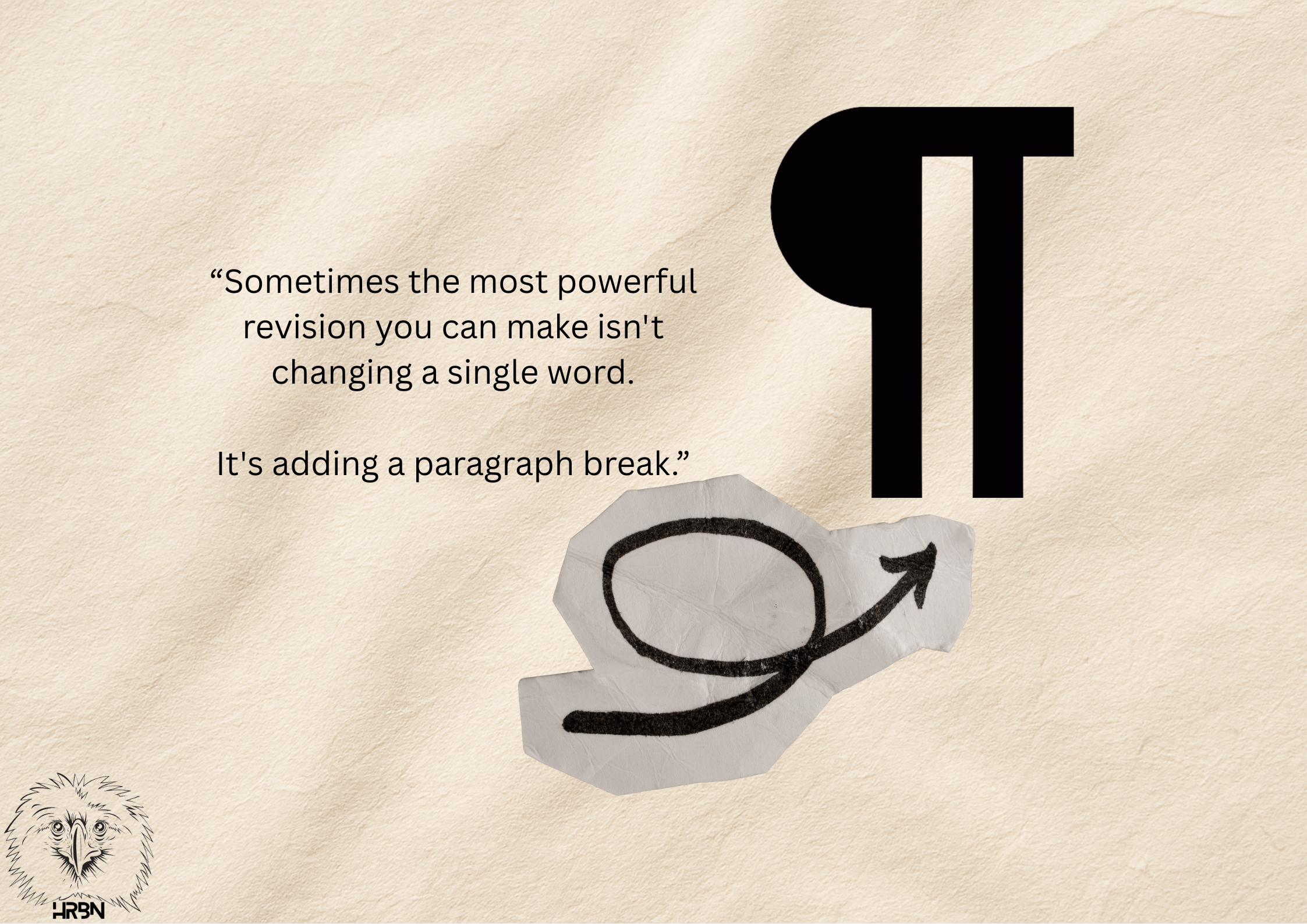
Sometimes the most powerful revision you can make isn't changing a single word.
It's adding a paragraph break.