

Free Indirect Style: The Technique That Makes Readers Forget They’re Reading
There’s a strange magic that happens in certain novels—a moment when the third-person narrator seems to dissolve, and suddenly you’re not reading about a character anymore. You’re inside them. Their thoughts feel like your thoughts. Their judgments land in your chest before you realize they aren’t yours. This isn’t an accident. It’s a technique called free indirect style, and once you learn to wield it, your prose will never feel the same.
Free indirect style (sometimes called free indirect discourse or free indirect speech) refers to a mode of third-person narration that takes on the voice and perspective of the point-of-view character—without switching to first person and without using dialogue tags or thought markers like “he thought” or “she wondered.” As Cameron Montague Taylor, the writing educator behind Tips from a Fiction Editor, explains, it’s “a zoom in from a more distant narration style to something that feels more like that character’s stream of consciousness—an immediate connection to what’s going on inside that character’s head without using verbatim thought.” The narration stays in third person and keeps the same tense as the rest of the story, but the voice shifts. The character’s personality, opinions, and worldview begin bleeding into the prose itself.
Why does this matter? Because free indirect style accomplishes several things at once. It helps you show rather than tell. It reduces what writers call “psychic distance”—the emotional gap between reader and character. And perhaps most importantly, it transforms narration from reporting into experience. As the Tips from a Fiction Editor video puts it: “Writers who are able to wield free indirect style effectively are the ones whose stories feel like really immersive experiences rather than like an incident report.”
Consider the difference. Here’s straight narration by Taylor: “He entered through the door and examined the room’s dark blue walls and tiger curtains. Above a blue velvet couch he found fantasy novels and pictures of The Lord of the Rings. He figured a fiction editor must work here and added it to his notes.” This is competent. It’s clear. But it’s also distant—we’re watching the character from outside, riding on his shoulder. Now here’s the same moment rendered in free indirect style: “He entered the office. Blue walls, tiger print curtains, fantasy novels, a bunch of pictures, Lord of the Rings hanging on the wall. Some kind of nerd worked here. One of those fairy f***ing fantasy types.” Can you hear the shift? The second version sounds like him. We’re no longer observing his actions—we’re inhabiting his mind.
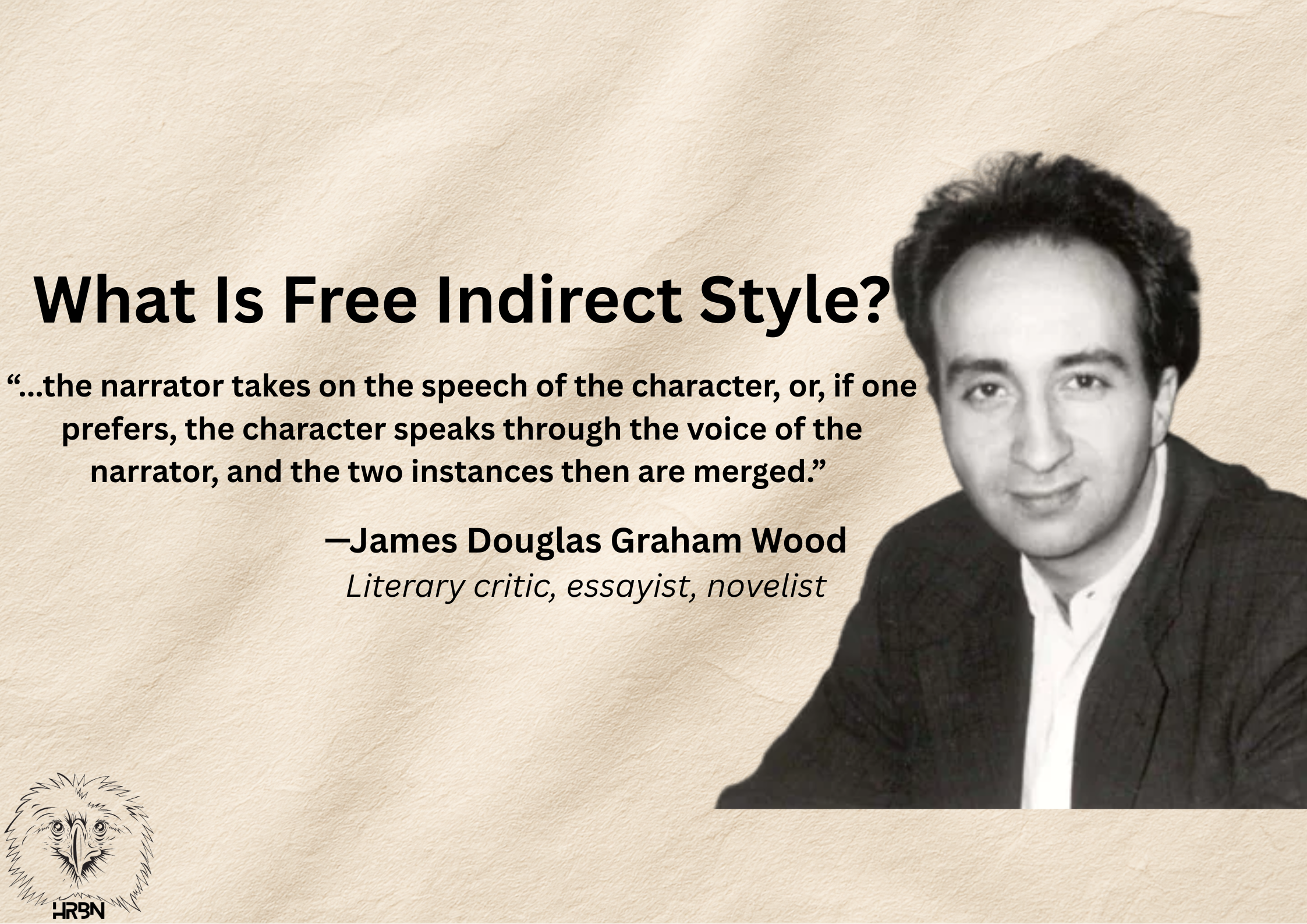
The technique has a long and distinguished history. Literary critic James Wood, in his influential book How Fiction Works, argues that free indirect style is one of the most important innovations in the history of the novel. He describes it as a mode where “the narrator takes on the speech of the character, or, if one prefers, the character speaks through the voice of the narrator, and the two instances then are merged.” Wood traces the technique’s refinement to Gustave Flaubert, whose Madame Bovary (1857) demonstrated what he calls “sustained exploitation of free indirect discourse.” But earlier practitioners include Jane Austen and Goethe, both of whom used the technique with remarkable sophistication in an era when omniscient narration was the dominant mode.
Austen, in fact, was a pioneer. According to Austen scholar Tom Keymer (as noted on Wikipedia’s entry on free indirect speech), Pride and Prejudice “filters its narrative, at different points, through no fewer than nineteen centres of consciousness, more than any other Austen novel.” That’s remarkable when you consider the novel was published in 1813. Austen was slipping into her characters’ heads—letting their biases, their snobberies, their blind spots color the narration—while most of her contemporaries were still writing from a godlike remove.
Henry James took the technique even further. In What Maisie Knew, James tells the story of a young girl caught between her viciously divorcing parents. The genius of the novel is that we experience the adult world through Maisie’s partial understanding—not because James tells us she doesn’t fully understand, but because the narration itself reflects her confusion. Wood gives an example: a passage where Maisie recalls visiting her governess’s daughter’s grave, and the narration notes that Mrs. Wix “was as safe as Clara Matilda, who was in heaven and yet, embarrassingly, also in Kensal Green.” That word “embarrassingly” is pure Maisie—a wealthy child uncomfortable with the meagerness of a servant’s grave. James doesn’t explain this. He lets the word do the work.
So how do you actually use free indirect style in your own writing? The key is understanding when to zoom in and when to stay at a comfortable distance. You don’t need to—and probably shouldn’t—write an entire novel in this mode. It would be exhausting for both writer and reader. Instead, think of free indirect style as a tool for moments of heightened interiority: when your character is making a judgment, experiencing a strong emotion, or processing something significant. One hallmark of the technique, as Tips from a Fiction Editor points out, is that “you’ll see that point-of-view character refer to themselves a lot less frequently. That’s because we’re in their head, and unless they’re doing some soul-searching or navel-gazing, their focus is usually going to be on what’s out there and what they’re currently experiencing rather than on their physical body and what they are doing.”
To practice, try this: take a passage of straight narration from your work-in-progress and strip out the dialogue tags, the “he noticed” and “she realized” constructions, and any sentences that begin with your character’s name or pronoun followed by a perception verb. Replace factual description with judgment. Instead of “He saw a painting on the wall,” try “A painting on the wall. Ugly thing. Who would hang that?” Instead of “She noticed the man was wearing an expensive watch,” try “An expensive watch. Of course. That type always had expensive watches.” The shift is subtle but powerful: you’re no longer reporting what the character observes—you’re letting them observe, in their own voice, through the narration itself.
A word of caution: free indirect style works best in third-person limited narration, where the reader is already anchored to a single character’s perspective. If you’re writing in omniscient mode—where the narrator is a distinct presence with their own voice—blending in a character’s thoughts can create confusion. Readers won’t know whose opinion they’re hearing. As one writing guide from The History Quill puts it, “If you blur an omniscient narrator’s voice with that of a POV character, things get very confusing. You end up with a narrative that feels clumsy and jarring.”
What makes free indirect style so effective, ultimately, is that it creates empathy without asking for it. When readers experience a character’s thoughts as narration rather than as marked-off interior monologue, they absorb those thoughts more directly. There’s no “he thought” to remind them they’re reading someone else’s mind. The boundary between reader and character softens. This is why the technique is so often associated with literary fiction that prioritizes psychological depth—but it’s equally useful in genre fiction, where getting readers to invest in your protagonist’s survival or success depends on making them feel what that character feels.
Free indirect style is one of those techniques that, once you see it, you can’t unsee it. You’ll start noticing it everywhere—in the novels you love, in the prose that pulls you under and won’t let you go. And once you start using it yourself, you’ll understand why so many writers consider it essential. It’s not just a craft trick. It’s a way of collapsing the distance between your reader and your character, of making fiction feel less like a story being told and more like a life being lived.